| Game fact | Source-based detail |
|---|---|
| Product | Casino Patience / Casino Patience Solitaire |
| Origin | ORYX Gaming; operator listing uses Bragg Gaming |
| Type | Solo casino patience / Klondike-style card game |
| Cards and tableau | 52 cards; seven columns containing 1–7 cards |
| Foundations | Four suit piles, Ace to King |
| Stock handling | One pass through the stock |
| Player aids | Autoplay and Undo mentioned in rules |
| RTP shown | 96.8% in operator-hosted rules and casino listing |
Checked 16 November 2026. The accessible rule PDF is in Romanian, so quoted English terms are translations or summaries rather than a reproduced English publisher rulebook.
Which product does the name refer to?
A 2018 ORYX distribution report identified Casino Patience as a real-money card title. Genting Casino now lists Casino Patience Solitaire under Bragg Gaming. Check the operator's help panel for the exact game build.
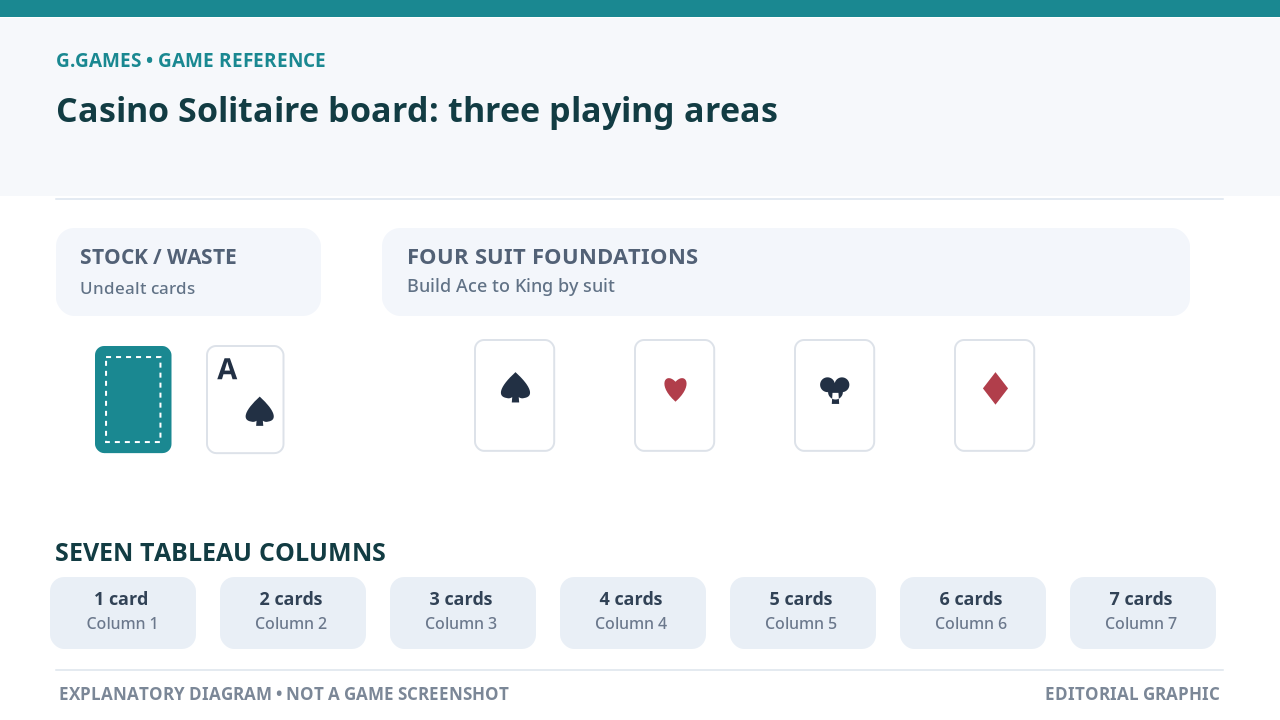
This page deals with the ORYX/Bragg product, not G.Games' Casino Solitaire. Both can use similar Klondike movements, but those similarities do not make their stakes, user controls or certified conditions identical.
The initial deal and areas of play
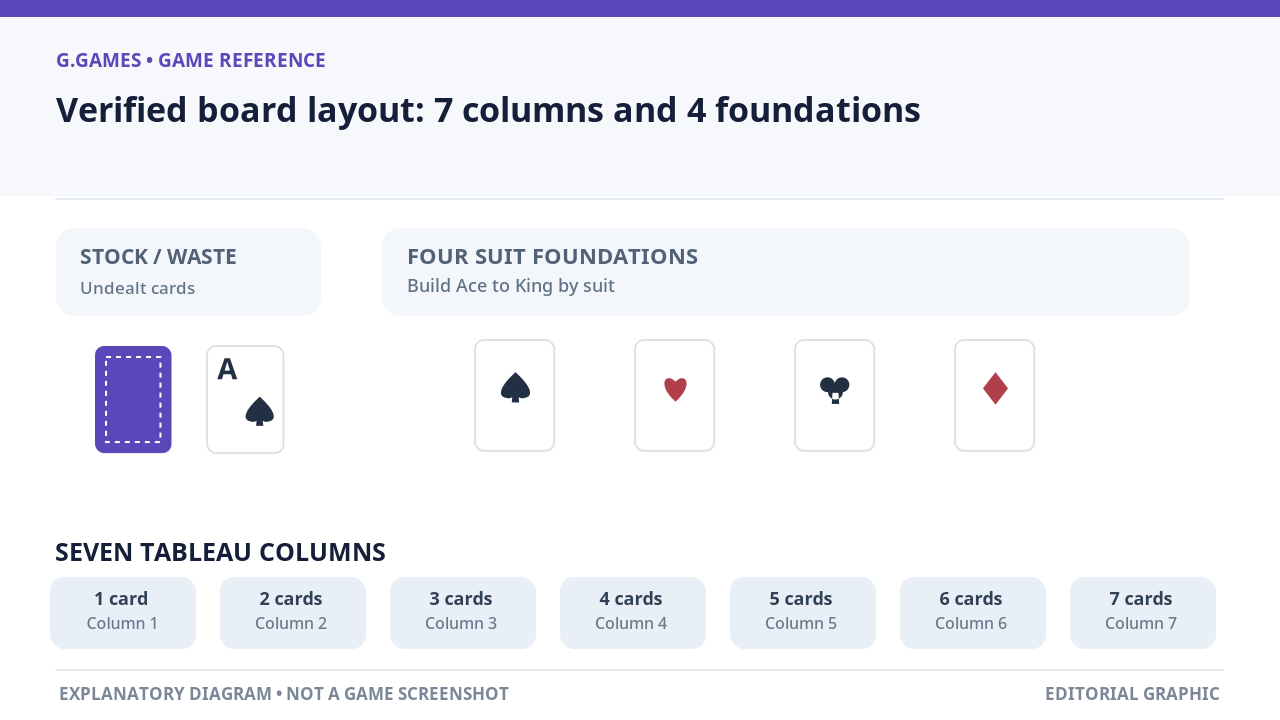
The operator-hosted Casino Patience rules specify a deck of 52 cards. Twenty-eight are dealt into seven tableau columns: one card in the first, two in the second, and so forth up to seven in the last. The top card in each column is face up, the rest face down. The four suit foundations begin empty; remaining cards sit in a face-down stock at the upper left.
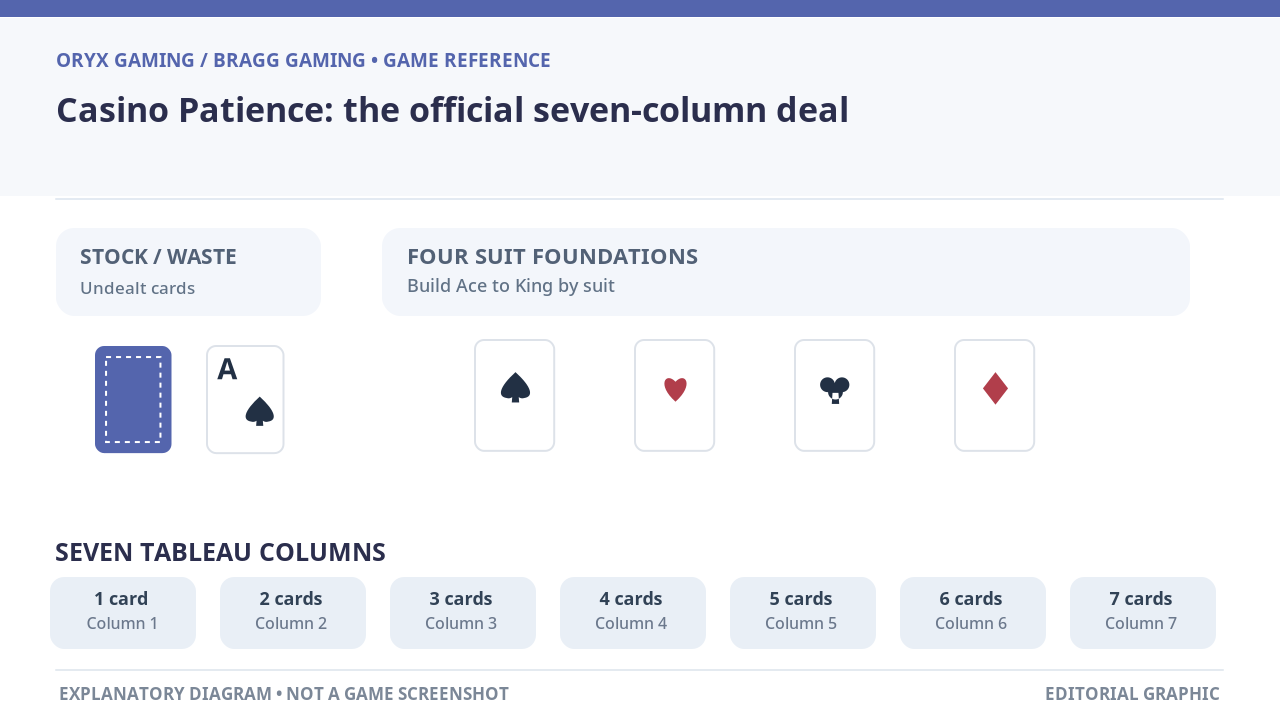
| Area | What the rule PDF says | Why it matters |
|---|---|---|
| Tableau | Seven columns, one to seven cards | The player must expose cards hidden underneath |
| Foundations | Four empty piles, one for each suit | Awards accumulate as cards are placed there |
| Stock / waste | Undealt stock turned into visible playable cards | Only a single pass is allowed |
| Score or win field | Displays the current credited winnings | It is not the same as net profit |
Unlike free solitaire apps with recycling, this game's rule PDF allows one stock pass. An X marks the end of the stock.
How to move cards in Casino Patience
The rule document describes the key moves in detail:
- Foundation moves: start with an Ace and build upward by rank within the same suit, ending with King.
- Tableau moves: build descending sequences while alternating red and black.
- Moving a sequence: select the highest card in the exposed run and drag the sequence to another valid column.
- Empty tableau column: only a King, or a sequence headed by a King, may occupy it.
- Waste card: move the available top card to a legal tableau or foundation destination.
- Newly exposed card: after removing the cards above a facedown tableau card, flip it face up.
- Stock advance: when no useful board move is available, turn the next stock card; the stock pass is finite.
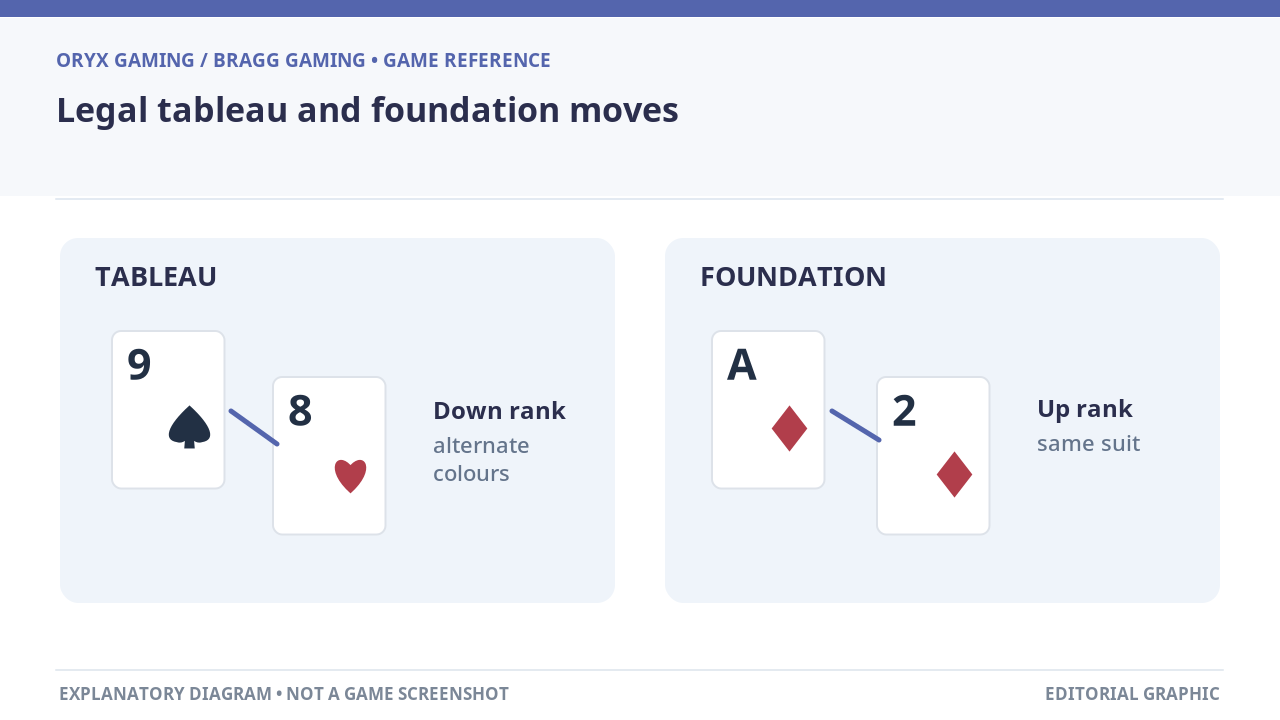
For example, a red Four fits on a black Five in the tableau, while 4♥ follows 3♥ on a heart foundation.
Double-click, Autoplay and Help
Double-click can send an eligible card to its foundation. Autoplay places available cards on foundations. Help and rules controls are also listed; neither promises a full clear.
The Undo feature: confirmed presence, unclear limits
The rule PDF includes an Undo entry, translated from “Anulare,” and explains it as returning to the previous move/hand. That confirms the existence of a rollback control. It does not, by itself, establish whether every action is reversible, whether stock draws count, whether exposed hidden cards can be turned back, or how many undos are allowed.
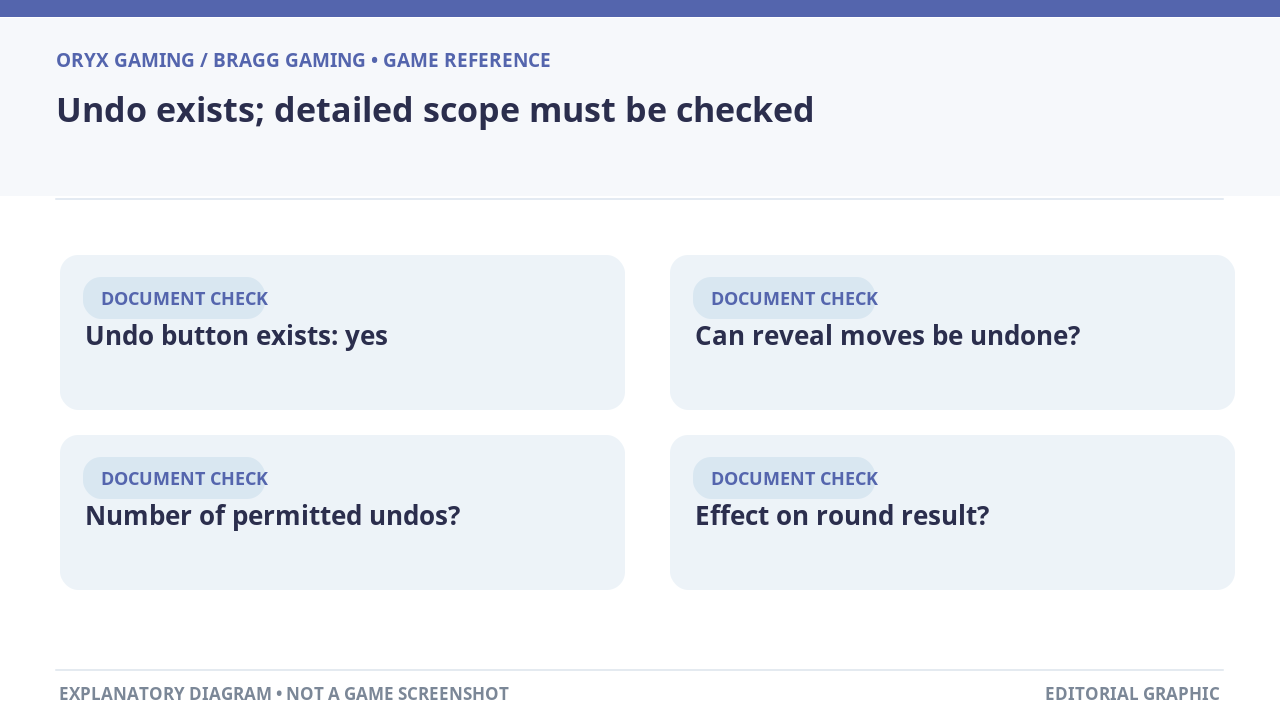
| Undo question | Status |
|---|---|
| Does the interface have Undo? | Yes, documented |
| Can it return to the previous action? | Described in the rule text |
| Can it undo a revealed hidden card? | Not clear from the accessible wording |
| Does Undo permit unlimited retries? | Not established |
| Does it change RTP? | No independent evidence of a changed RTP |
| Is Undo available in every operator build? | Must be confirmed in the deployed game |
G.Games' separate Casino Solitaire has documented single-undo restrictions. Do not apply them here. ORYX Undo limits still need an in-game check.
How the game awards foundation cards
The Romanian rule PDF describes a per-card credit system. Its wording associates a 52-unit stake with 5 units paid for each card successfully moved to a foundation. Read literally as the document's sample arithmetic, a full 52-card clear would produce 52 × 5 = 260 units gross, and a result with 13 banked cards would produce 13 × 5 = 65 units gross.
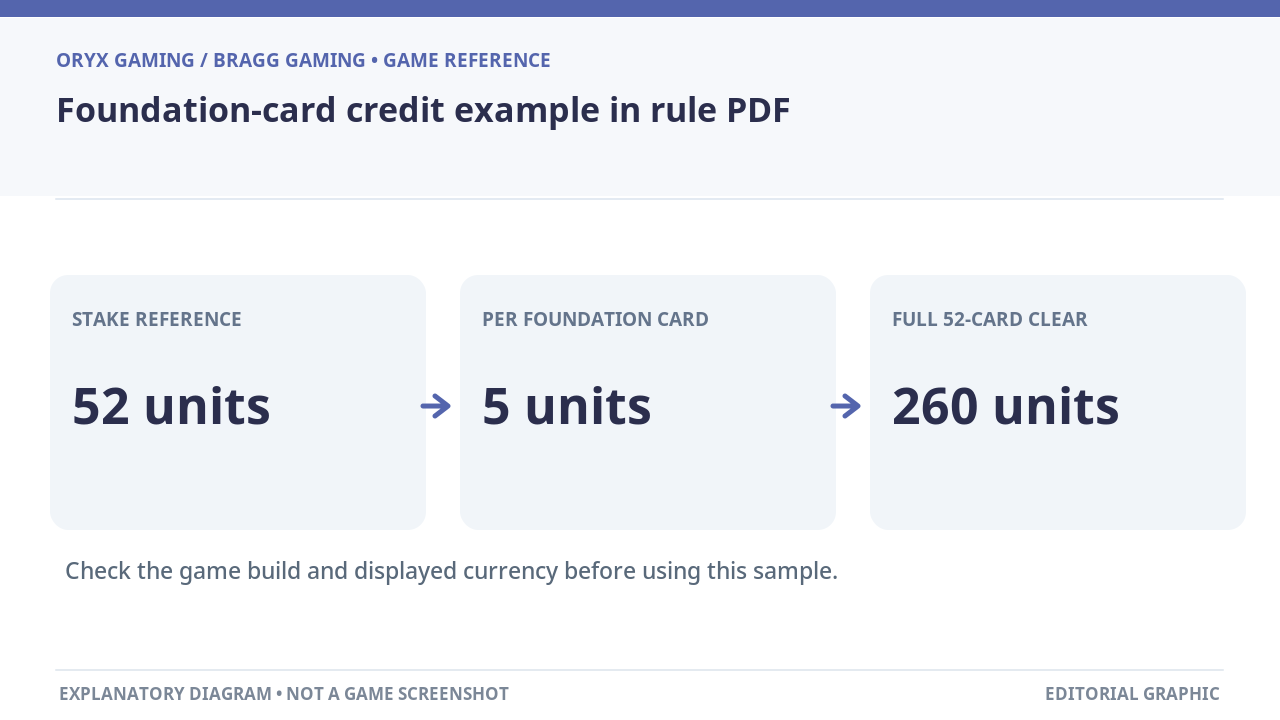
| Foundation cards | Illustrated gross award at 5 units/card | Stake reference in rule text |
|---|---|---|
| 0 | 0 units | 52 units |
| 13 | 65 units | 52 units |
| 26 | 130 units | 52 units |
| 52 | 260 units | 52 units |
These are calculations from the translated example, not a claim that every operator offers a 52-unit stake or the same denominations. Casino interfaces can display the same ratio at different currency amounts. The source adds that balance, wager and win are displayed in the player's currency and that listed prizes are totals with applicable multipliers included.
The publication-level distinction is between gross winnings and net result. A 65-unit gross award minus a 52-unit main stake leaves 13 units, excluding any separate conditions. No full side-bet table was verified.
RTP and game-end conditions
The operator-hosted PDF states 96.8% RTP. Genting Casino's game listing independently displays the same percentage and lists Bragg Gaming as the producer. These two references support reporting 96.8% as a published figure for the described product. They do not establish that every deployment or later revision uses identical settings.
A round ends after a full clear or when no moves remain; the end action collects current winnings. The score is a gross win display, while RTP is a long-run return measure.
A hypothetical mid-round decision
In a hypothetical deal, a red Six can move under a black Seven to expose a hidden card, while an Ace can move directly to its foundation. The sequence may affect access to later cards. Whether Undo can reverse either choice depends on the deployed rules.
Usability points worth checking in the real interface
The rules list sound, Autoplay, Undo, score, stake and help controls. Check these points in the deployed interface:
- Are the current bet and credited win clearly visible before and after each move?
- Does Undo show when it is active, and does the help page describe its limits?
- Are suit icons and card ranks readable without relying only on red/black colour?
- Does End Game request confirmation, given that it changes the round state?
- Does the rules screen state the deployed RTP and valid currency amounts?
These are review criteria, not claims that a particular mobile or desktop version passes them.
How it differs from 7 Solitaire and G.Games Casino Solitaire
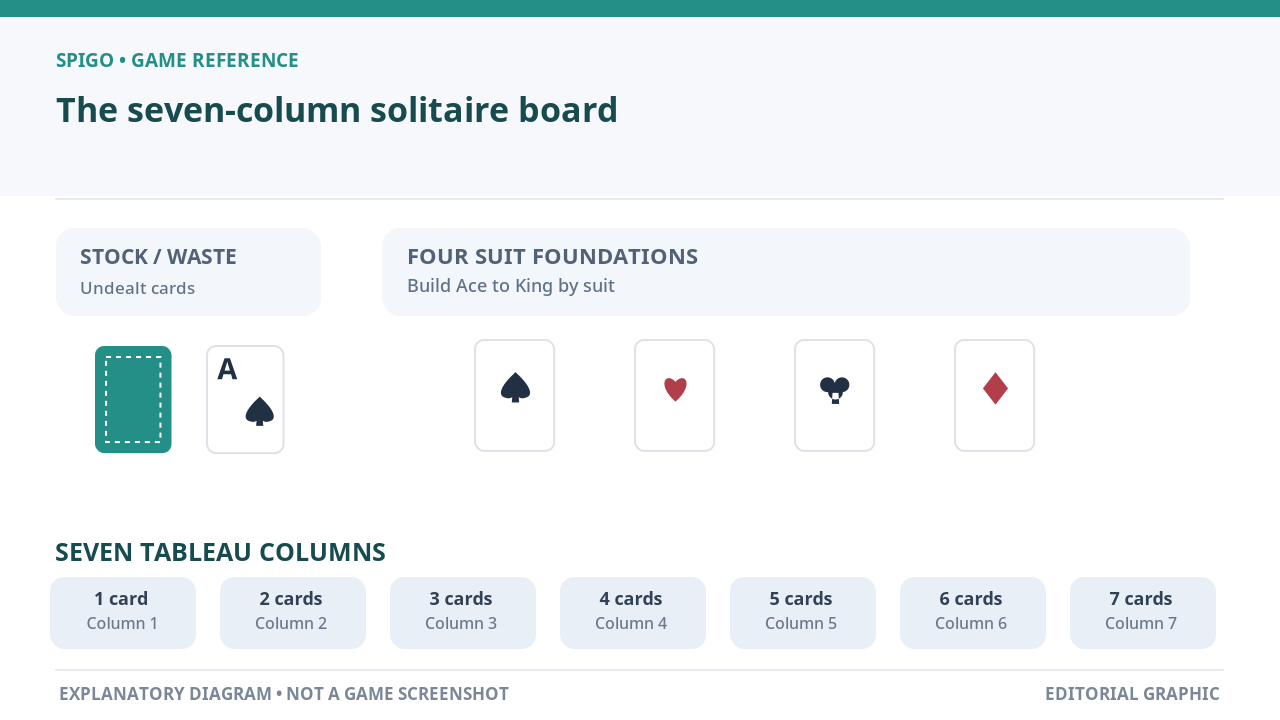
Spigo's 7 Solitaire links completion to a jackpot spin. G.Games' Casino Solitaire has two documented opening-deal side bets. ORYX's Casino Patience is distinguished by its operator-hosted rules and Undo control. Their paytables are not interchangeable.
Related reading: 7 Solitaire by Spigo and Casino Solitaire by G.Games.
Casino Patience Solitaire FAQ
Does Casino Patience use a standard 52-card deck?
Yes. The accessible operator-hosted rule document says one 52-card pack is used.
Is Undo available?
Yes. The rule document includes an Undo control, although its exact permitted actions and limits need confirming in the live game.
Can I turn through the stock again?
The source document says the stock can be passed through once.
Does the game pay for cards placed on foundations?
Yes. Its rules give a per-card credit example tied to the stake.
What RTP is published for Casino Patience?
Both the rule PDF and an operator listing show 96.8% for the described title.
Is Casino Patience the same as G.Games Casino Solitaire?
No. They are separate branded products, even though the underlying board structure is similar.
Sources and editorial record
- Casino Patience rules PDF, hosted by PublicWin, Romanian-language rules for layout, moves, credits, stock and Undo.
- Genting Casino — Casino Patience Solitaire, Bragg Gaming attribution and reported RTP.
- 2018 coverage of ORYX / Aspire Global distribution, historical identification of the ORYX Casino Patience product.
Editorial status: Core rules and published return found in operator materials. Confirm the exact operator build, payout display and Undo limits before presenting a deployment-specific review. Illustrated diagrams are not product screenshots.