| At a glance | Evidence available |
|---|---|
| Game | Vegas Solitaire by G.Games |
| Format | Seven-column solitaire card game, not a reel slot |
| Cards | 52, according to supplied content brief and independent game coverage |
| Release listed by catalogue | 20 June 2023 |
| RTP in third-party catalogue | 96.8%; supplier confirmation still needed |
| Interface observed in independent screenshots | Stock, tableau, foundations, Hint, Complete, Undo and End Game |
| Side bets shown in reviews | No Moves and Red or Black |
| Exact live paytable | Check operator's game help screen |
Research reviewed: 16 November 2026. Product identity is supported by independent catalogues and a design contractor's portfolio. Exact wager conditions have not been verified against an official G.Games rule sheet.
Vegas Solitaire is a card game, not a five-reel slot
Searching the title produces mixed descriptions. One aggregator applies generic slot metadata, including reels and free spins, to a game that its own illustrated coverage presents as Solitaire. For this game, the stronger visual evidence is a tableau, stock card, four foundation spaces and card-specific bet controls, not a reel grid.
Identify it by both title and provider. Unrelated browser games share the name and cannot establish its rules. Hotei Productions lists Vegas Solitaire for G.Games in its design portfolio, but supplies no gaming rulebook.
Board layout: what the interface shows
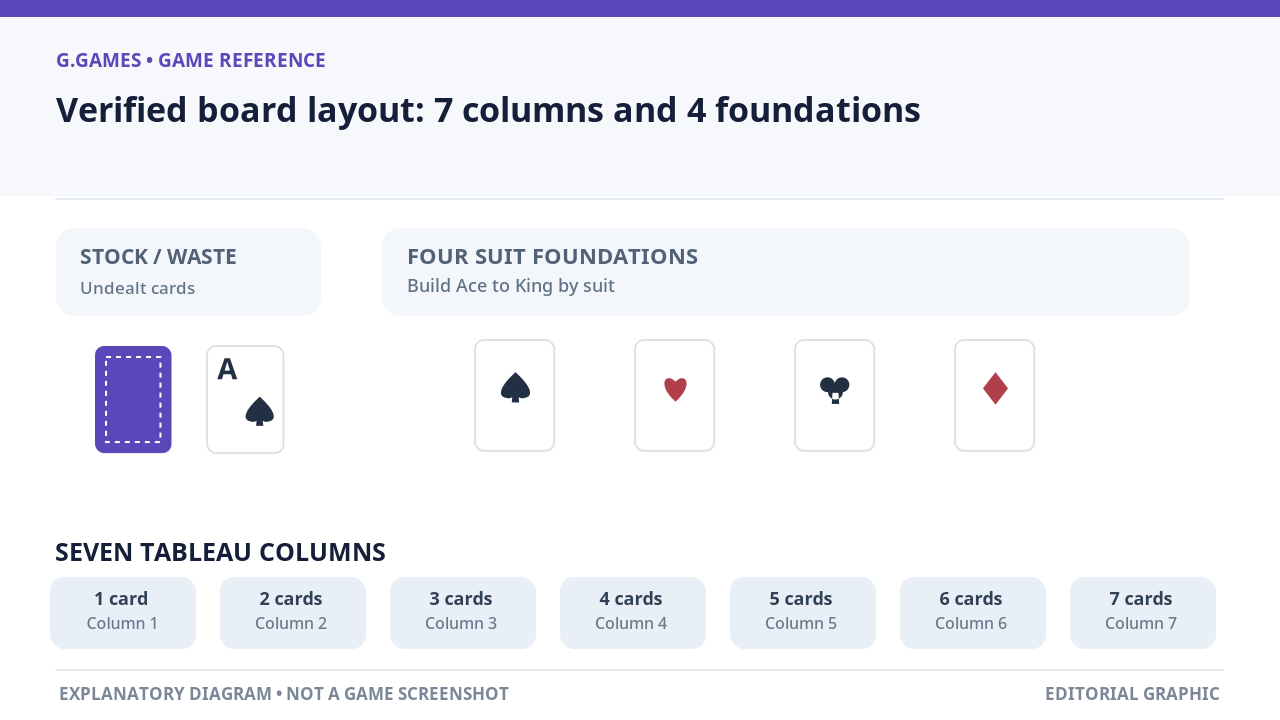
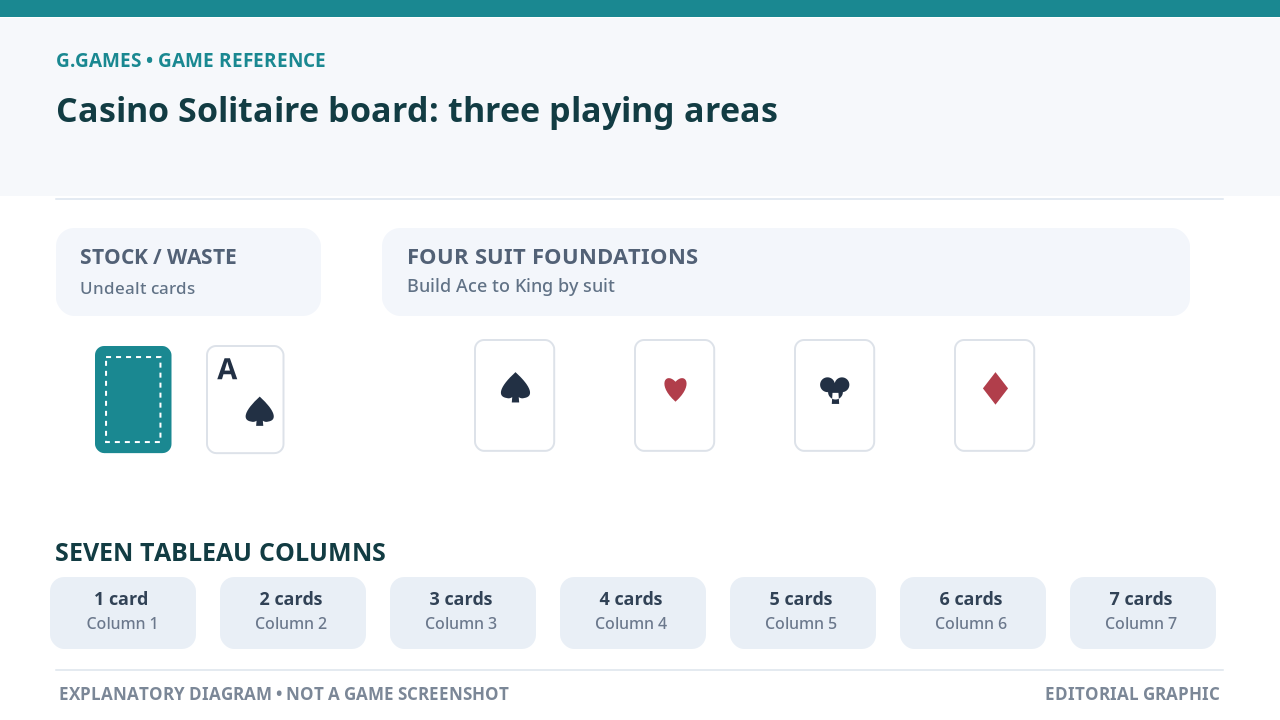
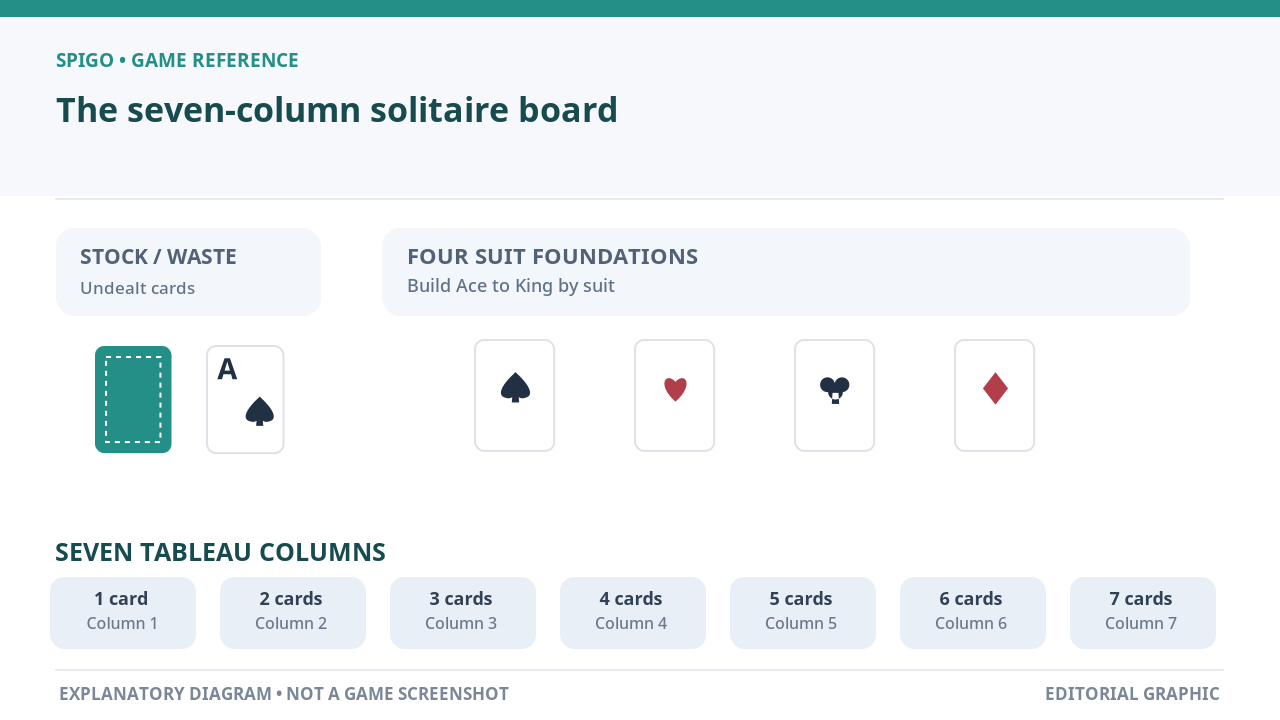
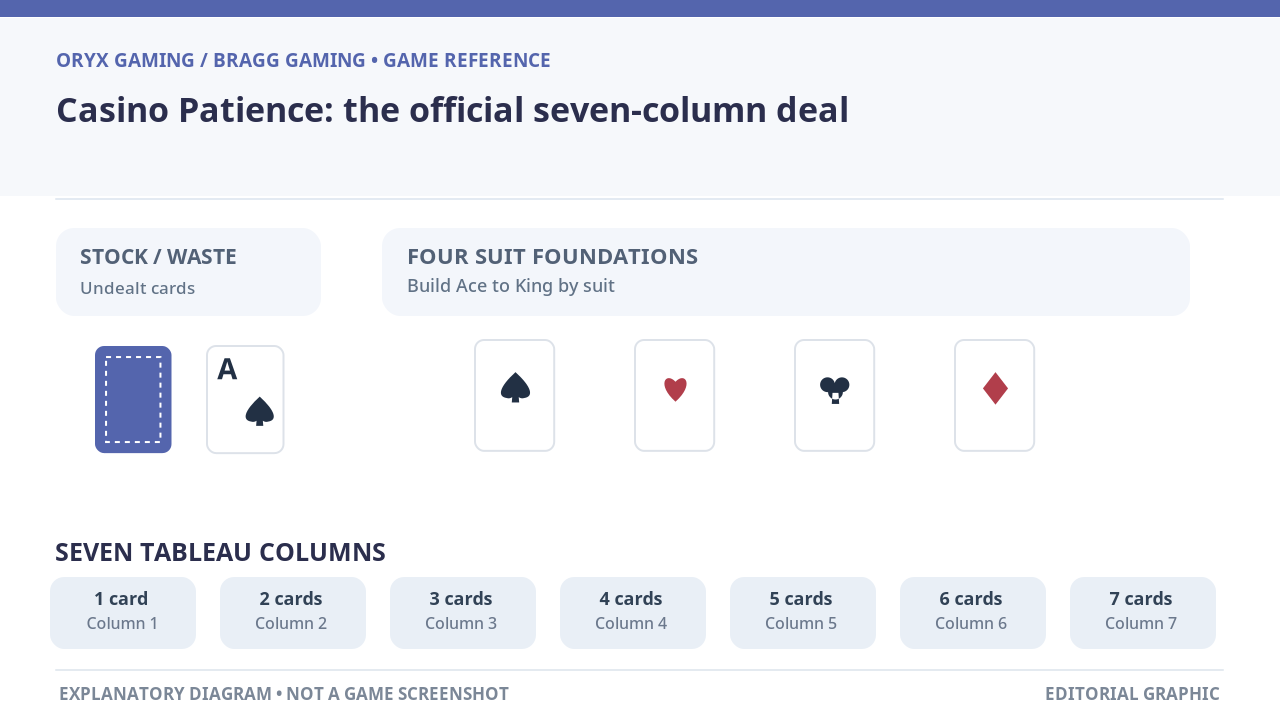
Independent images show the traditional seven-column structure with a stock pile and exposed cards. The supplied brief specifies 52 cards. The usual seven-column deal has columns holding one to seven cards, which accounts for 28 tableau cards and leaves 24 in stock; the exact deal sequence should still be checked in the live game's rule panel.
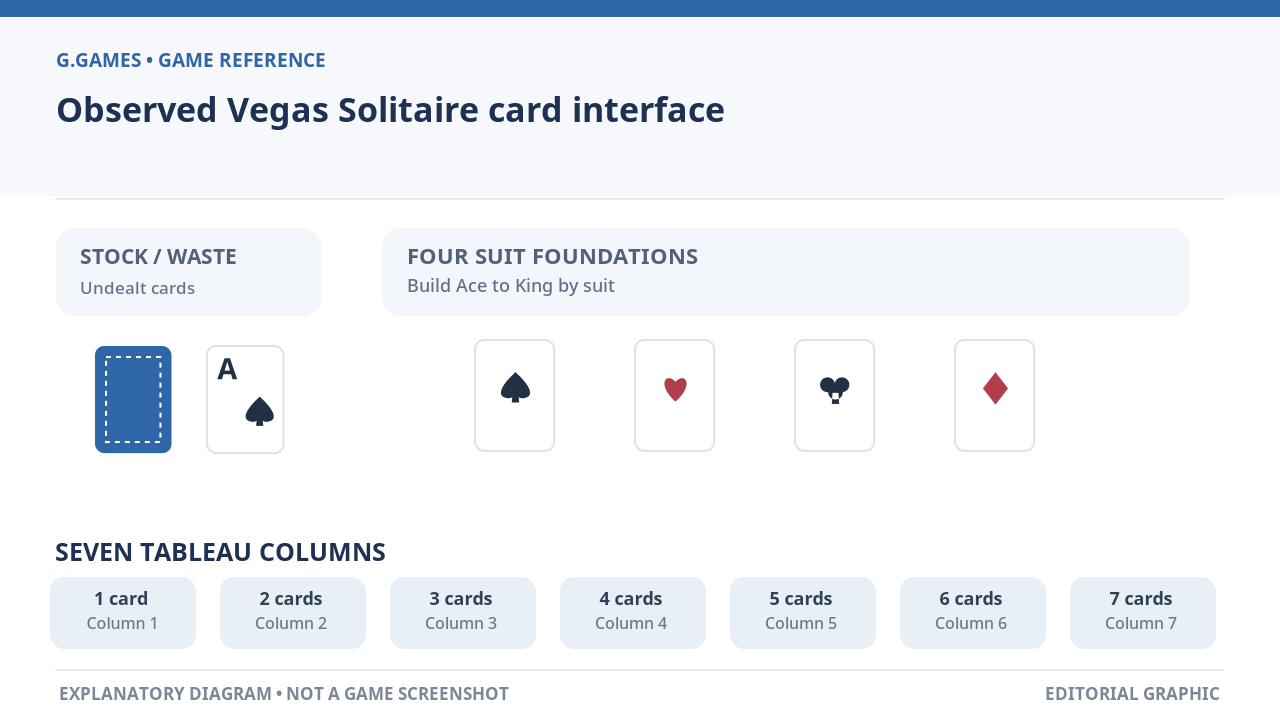
| Element | Seen or described | What must still be checked |
|---|---|---|
| Seven columns | Supplied brief and review images | Precise legal moves in this edition |
| Stock / drawn card | Visible in review screenshot | Number of passes and recycling rule |
| Four foundations | Visible card-game structure | Settlement per placed foundation card |
| Hint | Visible control | Whether it suggests any legal move or a recommended move |
| Complete | Visible control | When the automatic completion option becomes available |
| Undo | Visible control | Which actions it can reverse |
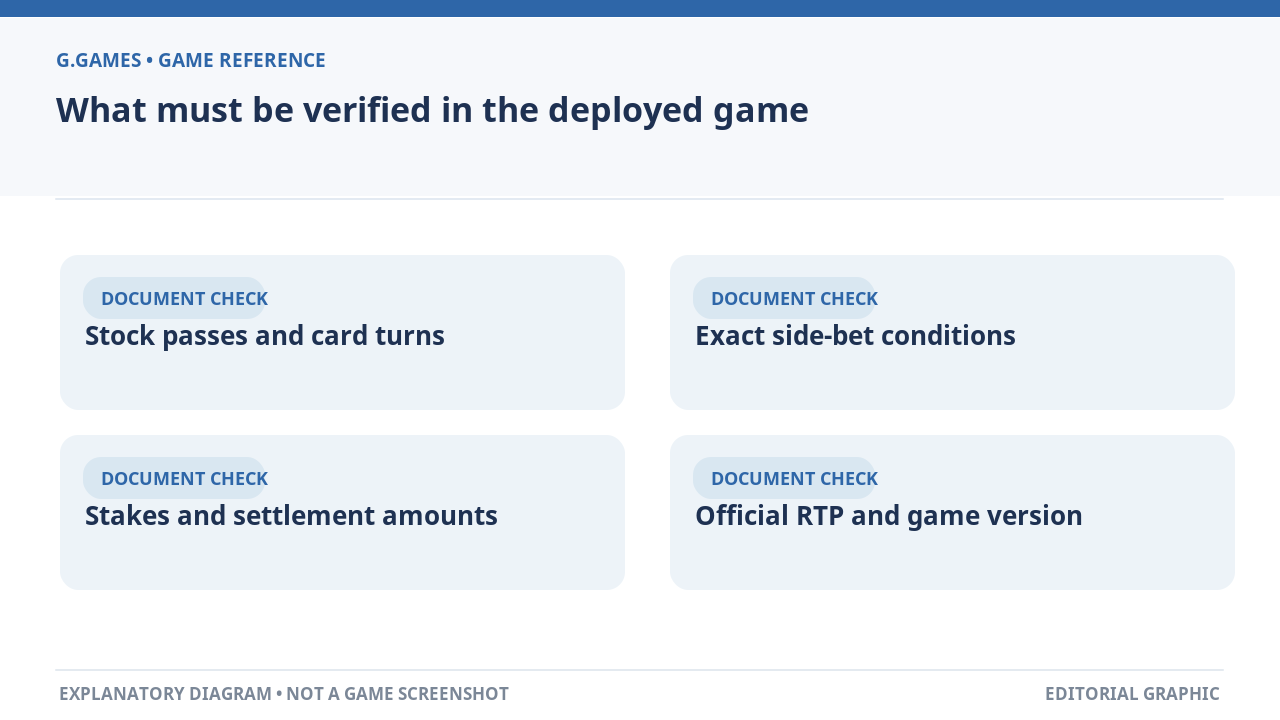
A screenshot of an Undo button does not show which actions it reverses. Stock passes also need explicit rules.
How a round appears to work
The publicly illustrated interface supports this broad sequence, with unresolved details separated from confirmed observations:
- Choose a main stake. The betting image displays stake choices and a lower amount described as the prize per card placed on a stack.
- Review additional wagers. Screenshots show No Moves and Red or Black controls beside the main selection.
- Start the deal. A stock pile, seven card columns and foundation positions appear.
- Move cards toward suit foundations. Visual evidence and G.Games' closely related card games support this as the overall objective, but the exact Vegas-specific move restrictions need the help file.
- End or complete the game. Buttons marked Complete, Undo and End Game are visible; settlement must follow the displayed paytable, not a rule borrowed from a different title.
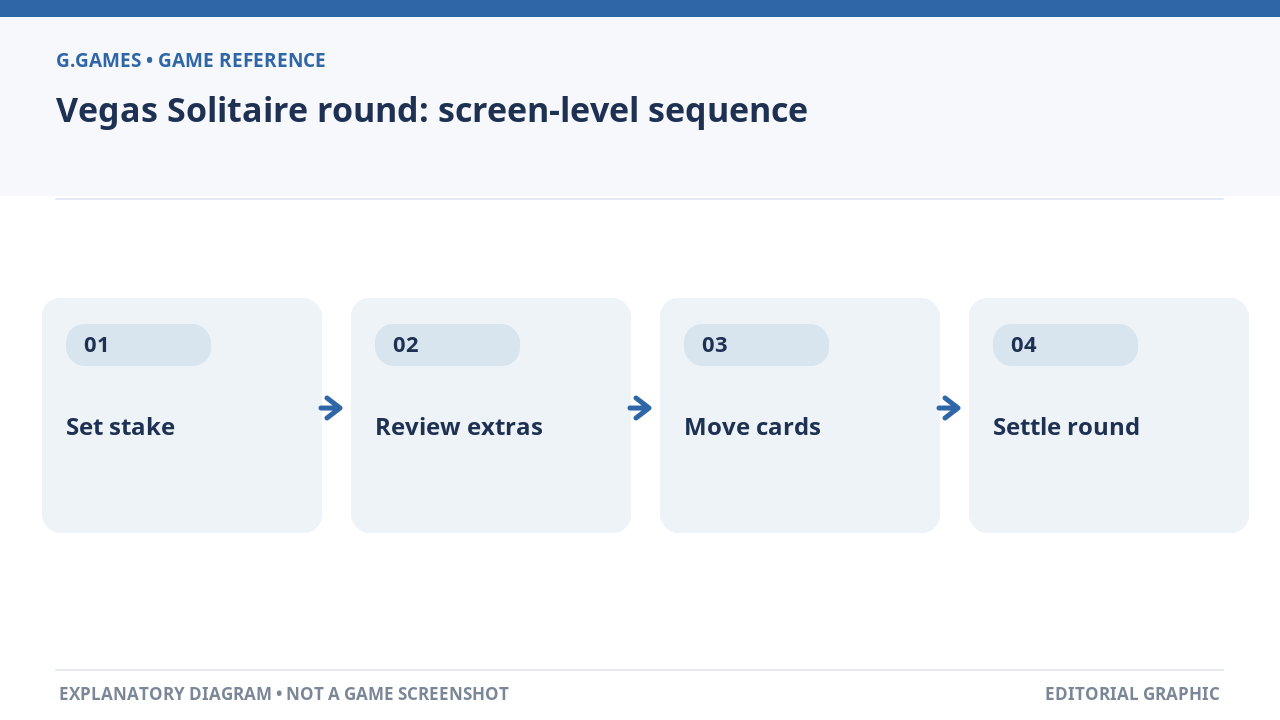
Tableau moves and stock play
Klondike ordinarily uses descending, alternating-colour sequences in the tableau and ascending, same-suit sequences on foundations. That is a useful reference for understanding what the pictured card arrangement is attempting. It is not independent proof that Vegas Solitaire has every stock, empty-column or undo rule of a standard Klondike app.
For example, a red Seven shown under a black Eight looks like a legal tableau sequence in Klondike. But whether a newly exposed stock card can be returned to the stock, and whether a moved foundation card can be brought back into a column, must come from the game's actual help panel. Those details can affect both the number of cards banked and the prize total.
Main-bet scoring and payout checks
The independent betting screenshot labels an amount for each card moved to a stack. This is consistent with the per-foundation-card model used in G.Games' documented Casino Solitaire and Retro Solitaire products. Consistency is not a substitute for an exact Vegas Solitaire paytable: stake grids, payout ratios and promotions should be taken from the Vegas title itself.
A conceptual calculation is straightforward. If a hypothetical interface says £0.20 per foundation card, then completing nine placements produces a £1.80 gross card award. A full 52-card result would show £10.40 at the same hypothetical rate. Neither figure is presented as an offered Vegas Solitaire stake.
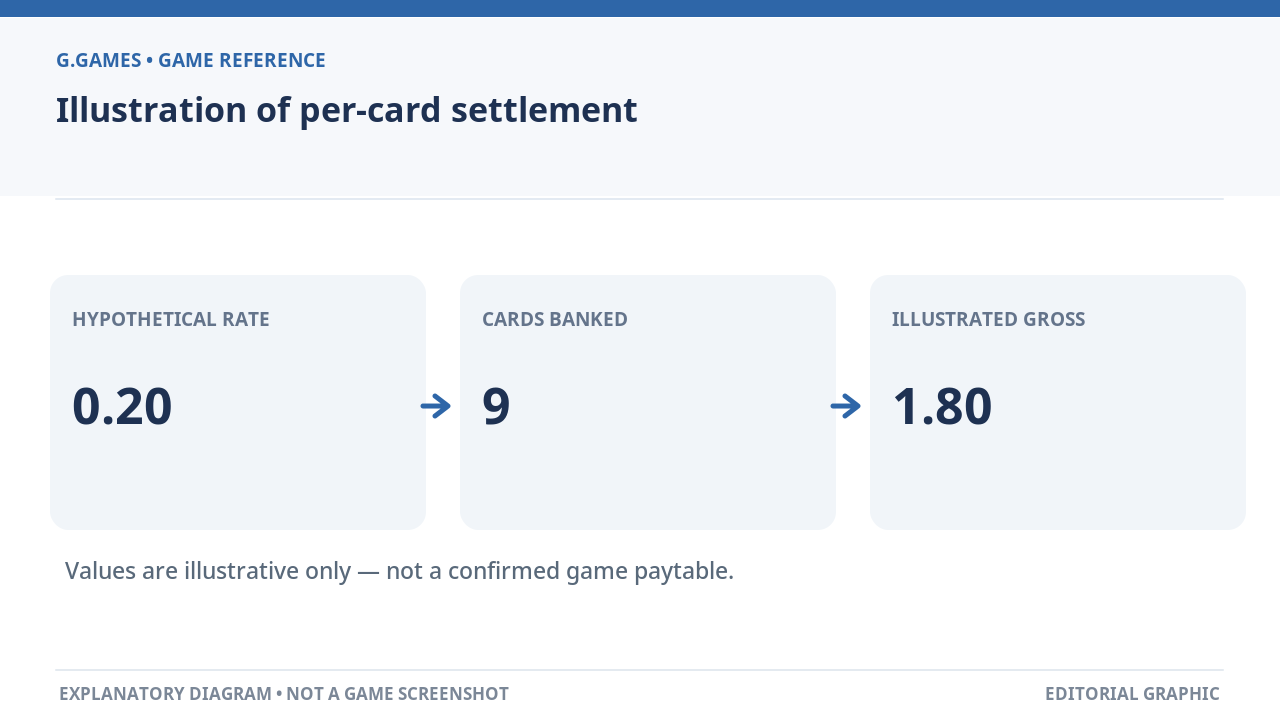
| Scenario | Cards banked | Illustrative £0.20/card payout | What is excluded |
|---|---|---|---|
| Early stop | 9 | £1.80 | Original main stake and extra wagers |
| Partial clear | 26 | £5.20 | Original main stake and extra wagers |
| Full clear | 52 | £10.40 | Original main stake and extra wagers |
Gross payout does not mean net profit. The net result is the amount returned after deducting every wager placed. Do not compare a £10.40 sample award with a separate game's “maximum win” label: those quantities could describe different betting arrangements.
No Moves and Red or Black side bets
Independent review screenshots label two extra bet areas. One describes No Moves and a factor of 15×; another shows Red or Black and 200×. These are also names and factors found in the official rules of G.Games' Casino Solitaire. The correspondence is strong enough to identify what the reviewed interface displays, but the independently located materials do not establish a current, signed manufacturer ruleset for Vegas Solitaire.
The key operational distinction is between an event at the starting deal and a dead end much later in the round. A wager called No Moves should never be described merely as “lose when you get stuck”; the game help file must define the adjudicated event. Red or Black also needs an exact definition of which starting cards count.
The presence of optional wagers means three different amounts can coexist on screen: the main stake, one or both extra stakes, and the payouts to which each may be entitled. A player should record the actual combined stake before starting rather than treating an advertised multiplier as an increase to the main card award.
What does 96.8% RTP mean for this version?
SlotCatalog's Vegas Solitaire listing attributes 96.8% to the G.Games title and describes the estimate as dependent on optimal card decisions. That number is third-party catalogue information, not a direct statement from an official Vegas Solitaire rule sheet reviewed here.
| Claim | Evidence status |
|---|---|
| Vegas Solitaire is a G.Games card title | Supported by multiple listings and a G.Games project credit |
| Catalogue RTP is 96.8% | Reported by SlotCatalog |
| The currently deployed game uses 96.8% | Not independently confirmed with in-game rules |
| Side-bet returns match other G.Games titles | Not established for Vegas Solitaire |
| Auto-completion maximizes real-world profit | Not supported |
RTP is a modeled average over many plays, usually tied to an assumed strategy. A particular shuffle can lead to less than the projected return or a large individual win. If the deployed game lists a different RTP, release date, paytable or market configuration, that version-specific information takes precedence.
A worked board decision, without invented rules
In a hypothetical deal, a red Jack can move under a black Queen while an Ace can go to its foundation. Which move comes first depends on hidden cards and stock access. Progress may affect foundation-card awards; neither move guarantees a profit.
How Vegas Solitaire differs from related titles
Retro Solitaire puts its 8-bit presentation at the centre of its identity; official rules and a manufacturer product page exist, although they disagree on RTP. Casino Solitaire by G.Games has a detailed manufacturer paytable and stated side-bet returns. Vegas Solitaire has a separately branded visual design and extensive independent interface coverage, but its supplier-rule document was not verified here.
For evidence specific to the other products, read Retro Solitaire by G.Games and Casino Solitaire by G.Games. Do not copy one product's 15×/200× payouts or 96.8% RTP into this title's structured data as manufacturer-certified figures.
Vegas Solitaire FAQ
Is Vegas Solitaire by G.Games a slot machine?
The reviewed game visuals depict solitaire cards, tableau columns and suit foundations, not spinning reels. Some directories categorize casino titles broadly as slots.
Does the game use 52 cards?
The supplied content brief specifies 52 cards, matching the seven-column game shown in reviews. Check the deployed rules for precise stock handling.
Does Vegas Solitaire have side bets?
Independent screenshots show No Moves and Red or Black selections. Their current conditions and availability should be verified inside the game.
Is 96.8% the official RTP?
It is reported in a third-party catalogue. An exact manufacturer-hosted Vegas rules page was not found during this check.
Does the Complete button guarantee a full-clear payout?
A Complete control is visible in review screenshots, but the rules for its activation and result need confirmation. It should not be treated as a guarantee.
Sources and editorial record
- SlotCatalog — Vegas Solitaire by G.Games, listing, reported date and third-party RTP.
- Hotei Productions — Vegas Solitaire project, design credit naming G.Games.
- Chipy — Vegas Solitaire interface and bet screenshots, visual reference for controls and wagering layout.
- SlotsJudge — Vegas Solitaire betting interface, secondary description of side-bet screens.
Editorial status: Research draft. The missing manufacturer-rule sheet remains a publication check for exact stock limitations, side-bet resolution, stakes and formal RTP. The diagrams are explanatory illustrations, not game screenshots.