| Verified fact | Casino Solitaire by G.Games |
|---|---|
| Provider | G.Games |
| Supplier-listed release date | 12 November 2020 |
| Game | Klondike / Las Vegas-scoring card game |
| Layout | 52 cards; seven tableau columns; four suit foundations |
| Stock rule | Single pass through play deck |
| Main-game RTP | 96.8% assuming optimal card decisions |
| Side bets | No Move 15×; Red and Black 200× |
| Supplier-listed volatility | Low |
Source check: 16 November 2026. Figures below come from the manufacturer-linked rules, version 1.0. Currency illustrations are examples and do not establish local availability.
Which Casino Solitaire game is this?
The exact provider name is essential. G.Games' Casino Solitaire is documented on G.Games' website, which links directly to a rules page and presents the title as a Klondike game designed for real-money play. Another product called Casino Solitaire (Flipluck) is listed under PureRNG by a third-party catalogue. Those are separate product identities; their features and RTP cannot be pooled.
The G.Games title is not a slot with reels, symbols and paylines. Its game board contains familiar card areas, while the settlement system follows the number of cards promoted to foundations. A completed four-suit arrangement earns the highest main-game card count, but many rounds end with only some cards banked.
The board and the start of a round
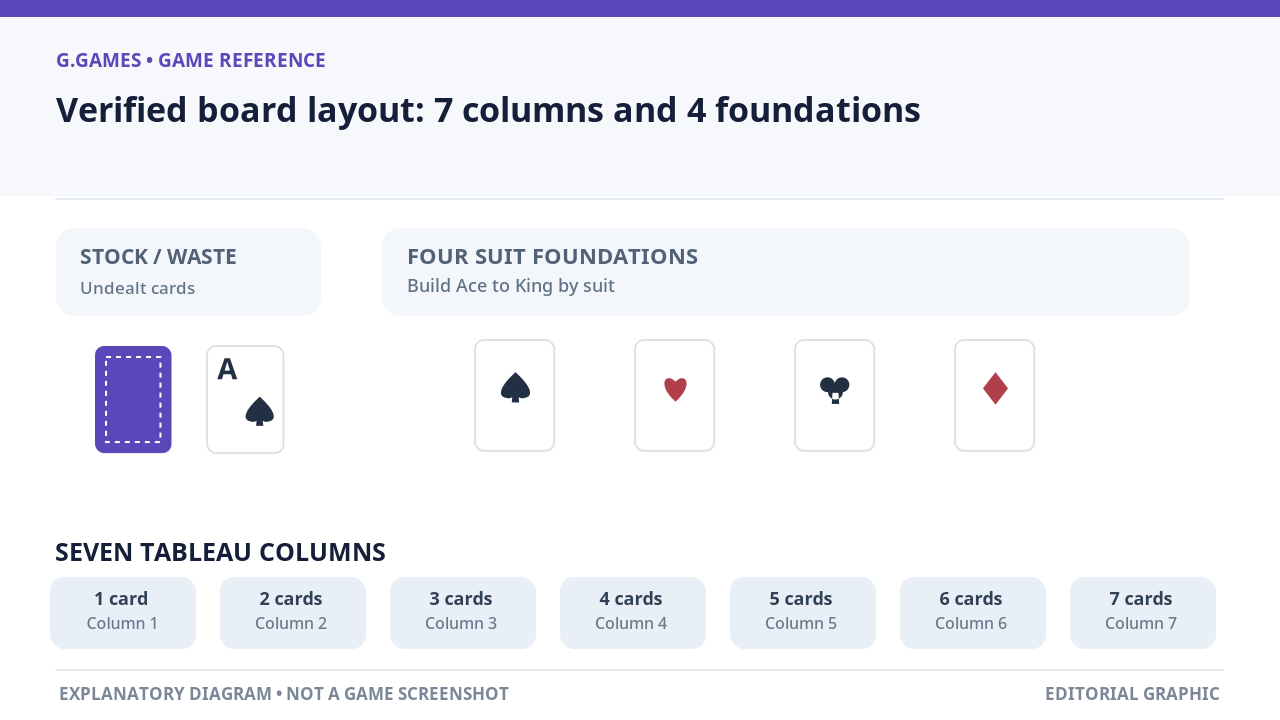
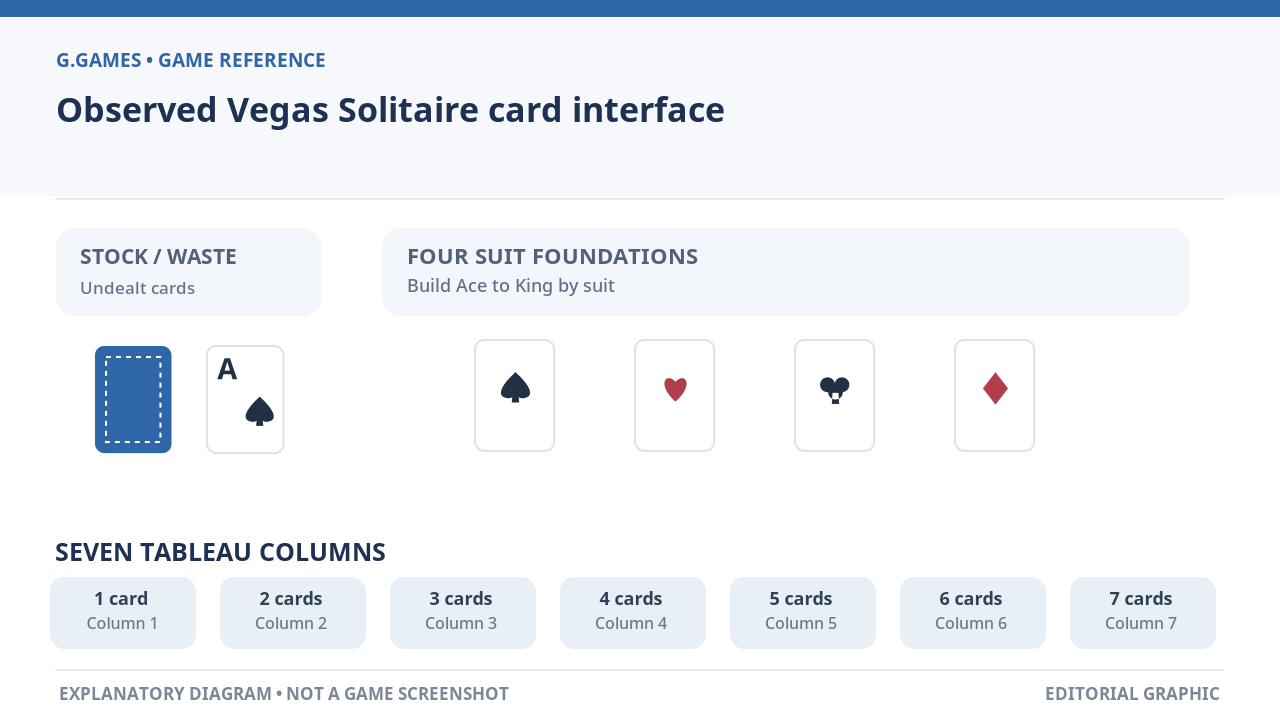
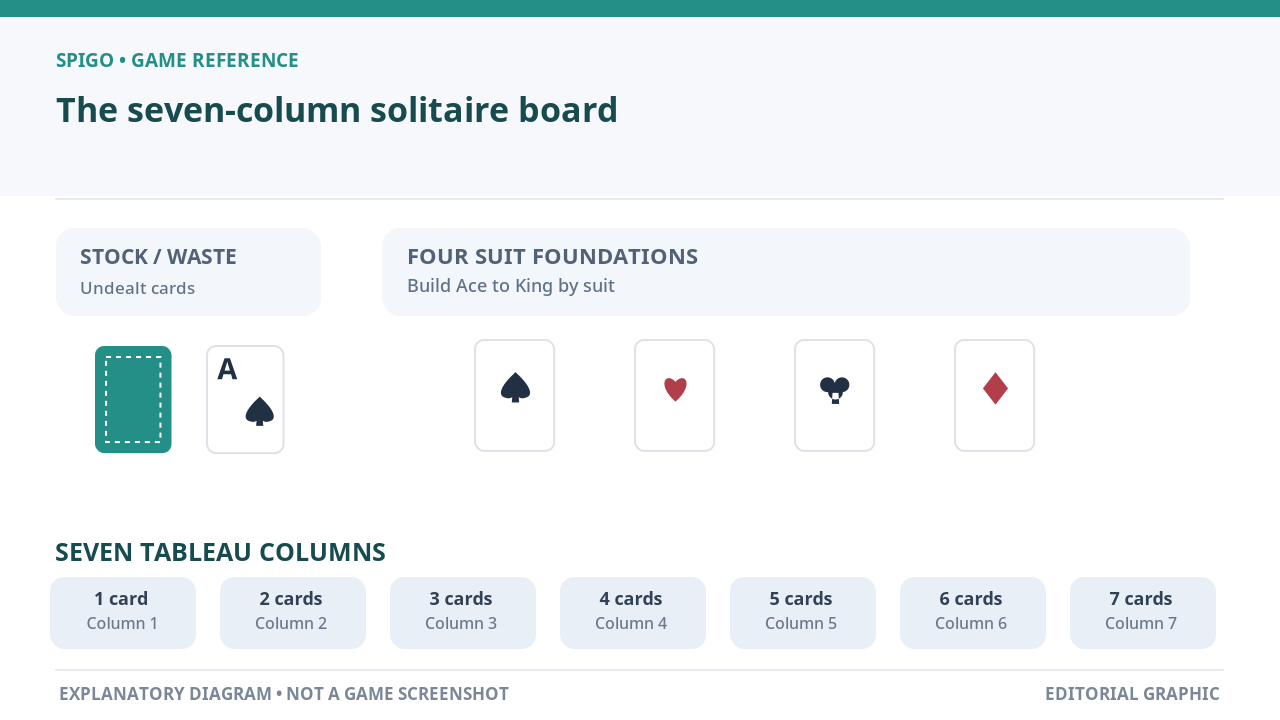
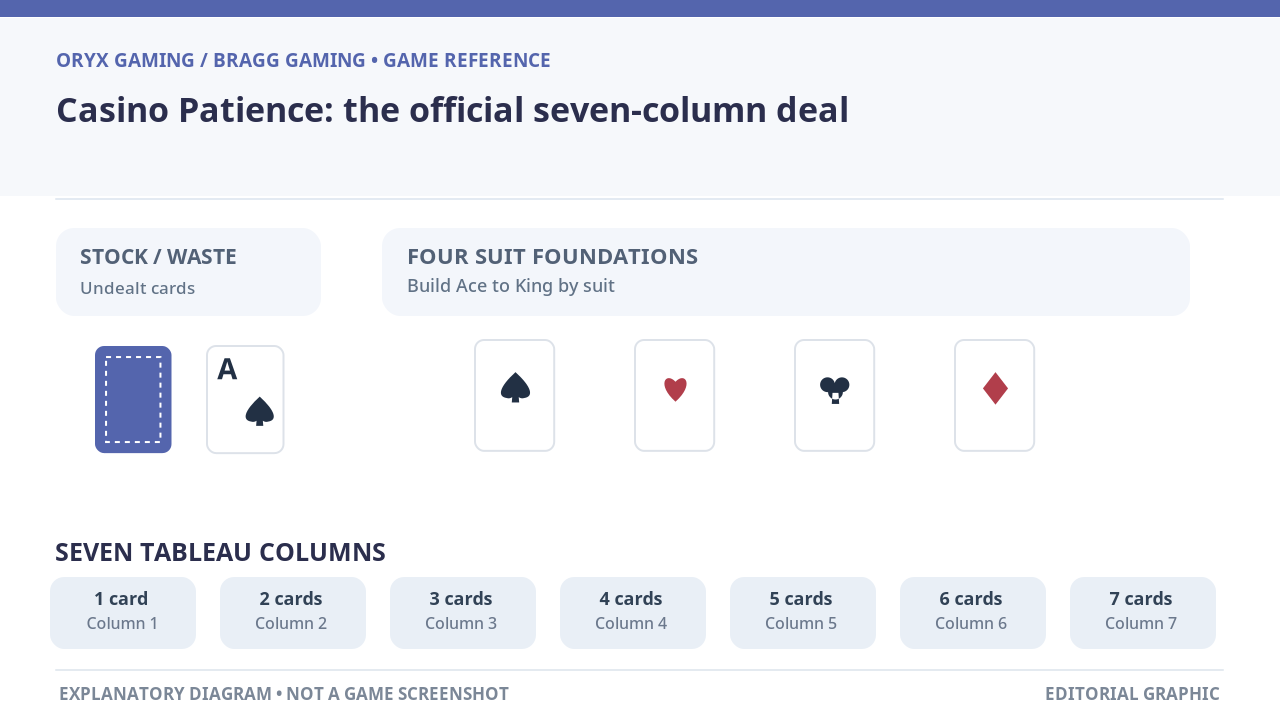
The rules specify a standard shuffled 52-card deck. Seven tableau piles receive one to seven cards from left to right, with the final card of each pile face up. Four foundations begin empty. The other 24 cards make up the stock, sometimes called the play deck in G.Games' documentation.
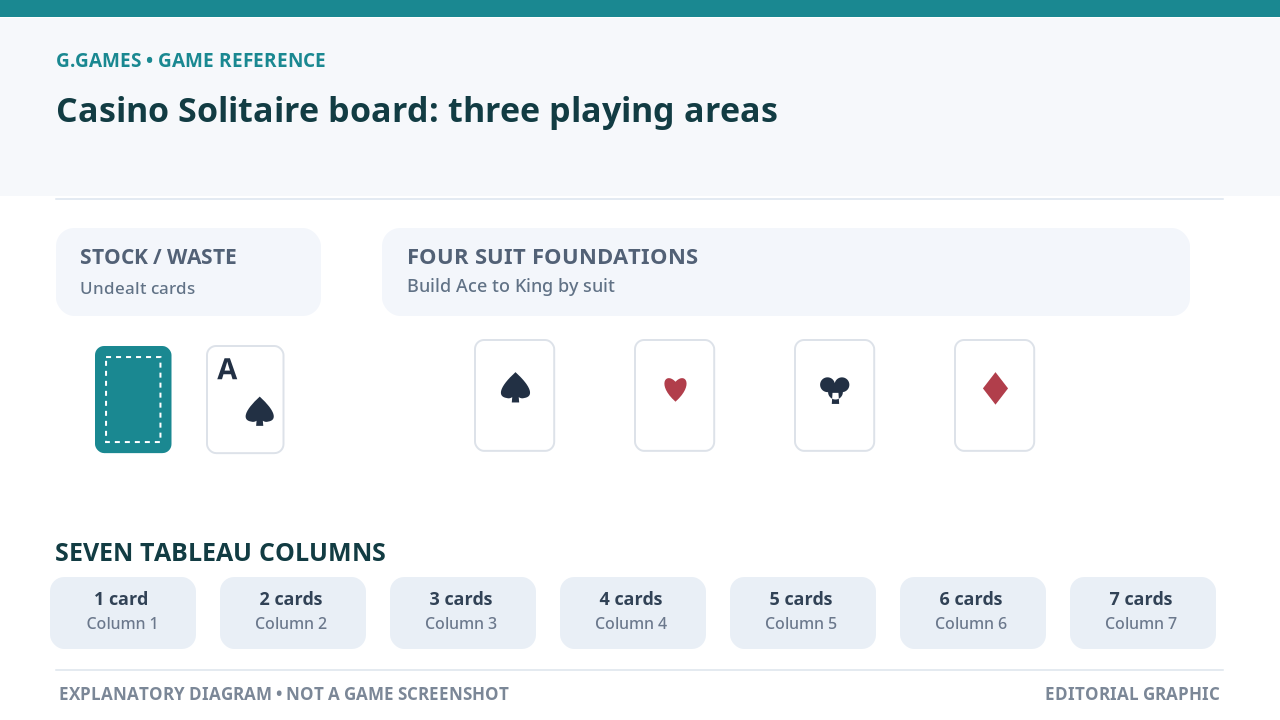
| Board area | Starting state | Purpose |
|---|---|---|
| Tableau | Seven columns, 28 cards total | Rearrange face-up cards and uncover hidden cards |
| Foundations | Four empty suit piles | Build upward from Ace to King, earning main-game card awards |
| Stock/play deck | 24 undealt cards | Reveal further playable cards in the permitted order |
The rules permit only one journey through the play deck. Any strategy based on cycling through the stock repeatedly belongs to a different implementation and must not be applied here.
How to play Casino Solitaire by G.Games
- Set the main stake. The bet selector displays the amount awarded for each card moved to a foundation.
- Choose whether to add side bets. No Move and Red and Black are separate wagers and may be unavailable in some jurisdictions.
- Deal the cards. Seven face-up tableau cards, four empty foundations and the play deck are visible at the start.
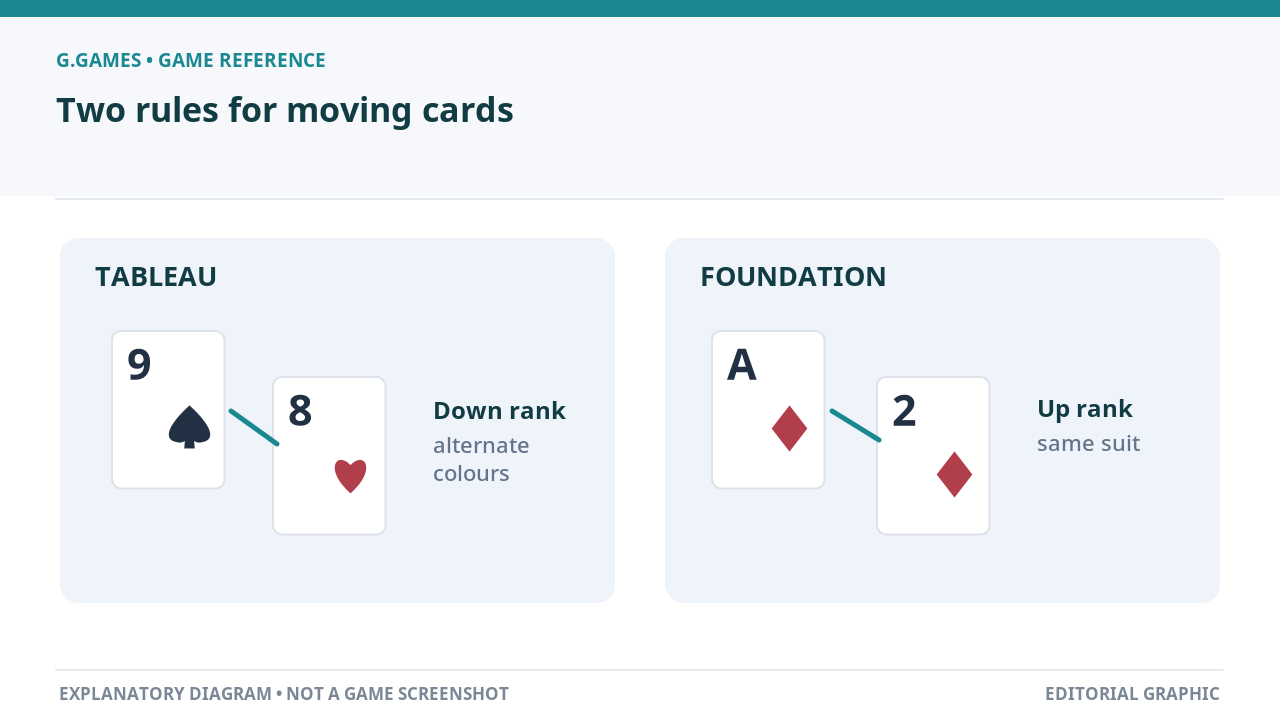
- Move cards legally. Build tableau columns down in rank with alternating colours; send Aces and subsequent same-suit cards to foundations.
- Turn stock cards as needed. Play available stock cards before the single permitted stock pass expires.
- Finish or end the hand. The number of cards delivered to foundations determines the main-game gross prize.
Tableau and foundation rules
A black Nine can receive a red Eight; a red Eight cannot receive a red Seven. A descending alternating-colour run can move together if its leading card fits the destination column. On foundations, rank increases instead of decreases and suits must match: A♣, 2♣, 3♣, and so on.
The official controls include drag-and-drop moves. Double-clicking can execute an available automatic move. Hint points to a possible next action; it does not state what your ultimate payout will be. Auto Play follows the program's calculated strategy and may stop without clearing the deck. These descriptions are from the linked rules rather than assumptions about standard solitaire apps.
Undo is limited
The rules permit one Undo for a play-deck turn or a card moved from a column onto a foundation. Exposing a previously facedown tableau card cannot be undone. The player should not treat Undo as an unlimited way to test alternative hidden cards.
Main-bet payouts: what the official example means
The manufacturer's paytable gives a 1.04 main stake as an illustration. It specifies 0.10 paid per foundation card and therefore a 5.20 top main-game prize if all 52 cards reach the foundations. The published calculation is: 1.04 ÷ 10.4 = 0.10 per card; 0.10 × 52 = 5.20 at a full clear. The same source gives a theoretical 1-in-21.52 likelihood for placing every card under its modeled conditions.
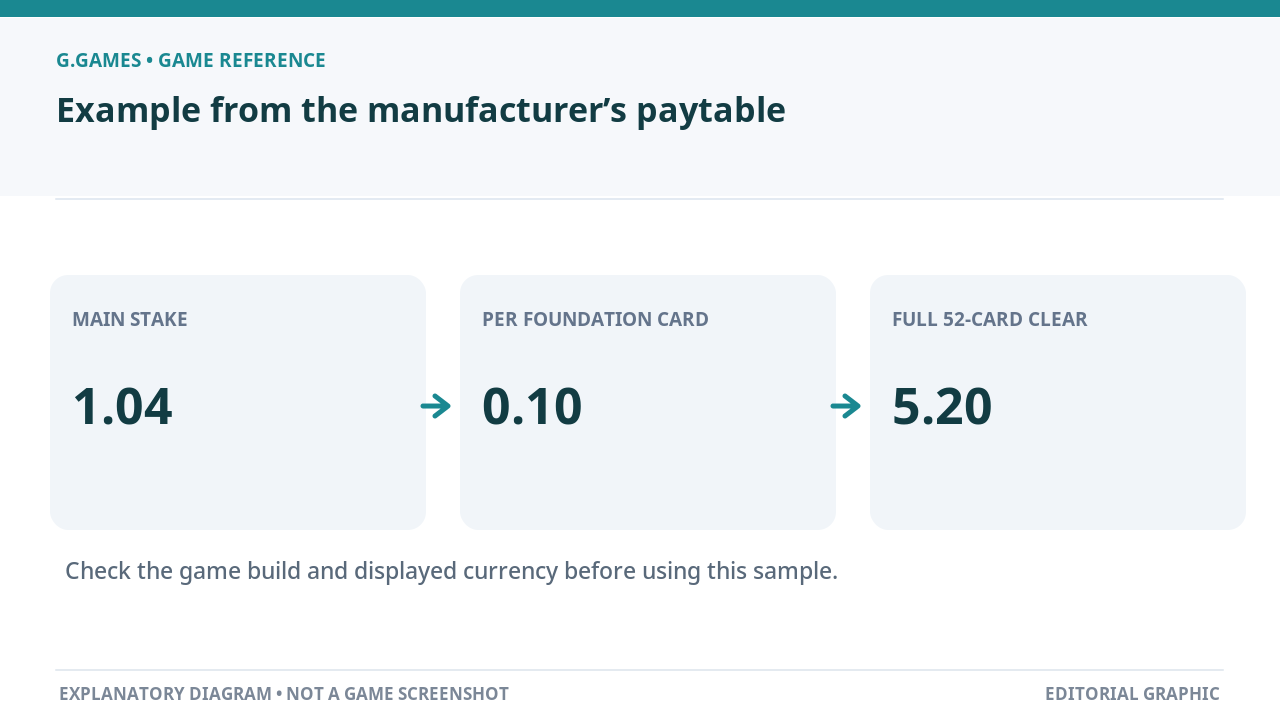
| Cards placed on foundations | Gross main-game award at 0.10/card | Main-game result after 1.04 stake |
|---|---|---|
| 0 | 0.00 | −1.04 |
| 8 | 0.80 | −0.24 |
| 16 | 1.60 | +0.56 |
| 24 | 2.40 | +1.36 |
| 52 | 5.20 | +4.16 |
The monetary unit is omitted because the source example does not establish a single currency for every market. The calculations exclude any additional side-bet stakes or prizes. The 715× “win” label on the G.Games product page is a separate headline and should not be confused with the 5× main-stake full-clear outcome in this particular sample stake configuration.
Side bets are settled separately
The official rules specify two optional wagers on the initial deal. Their prize factors and return values differ materially from the 96.8% main game.
| Bet | Winning event | Prize factor | Published side-bet RTP |
|---|---|---|---|
| No Move | No legal initial move | 15× | 86.64% |
| Red and Black | All starting cards red or all black, including the indicated stock card | 200× | 83.2% |
The rules illustrate 3.00 × 15 = 45.00 for No Move and 0.50 × 200 = 100.00 for Red and Black. They also give odds of about 1 in 17 and 1 in 241 respectively. These are source examples; stake denominations may differ by operator or region.
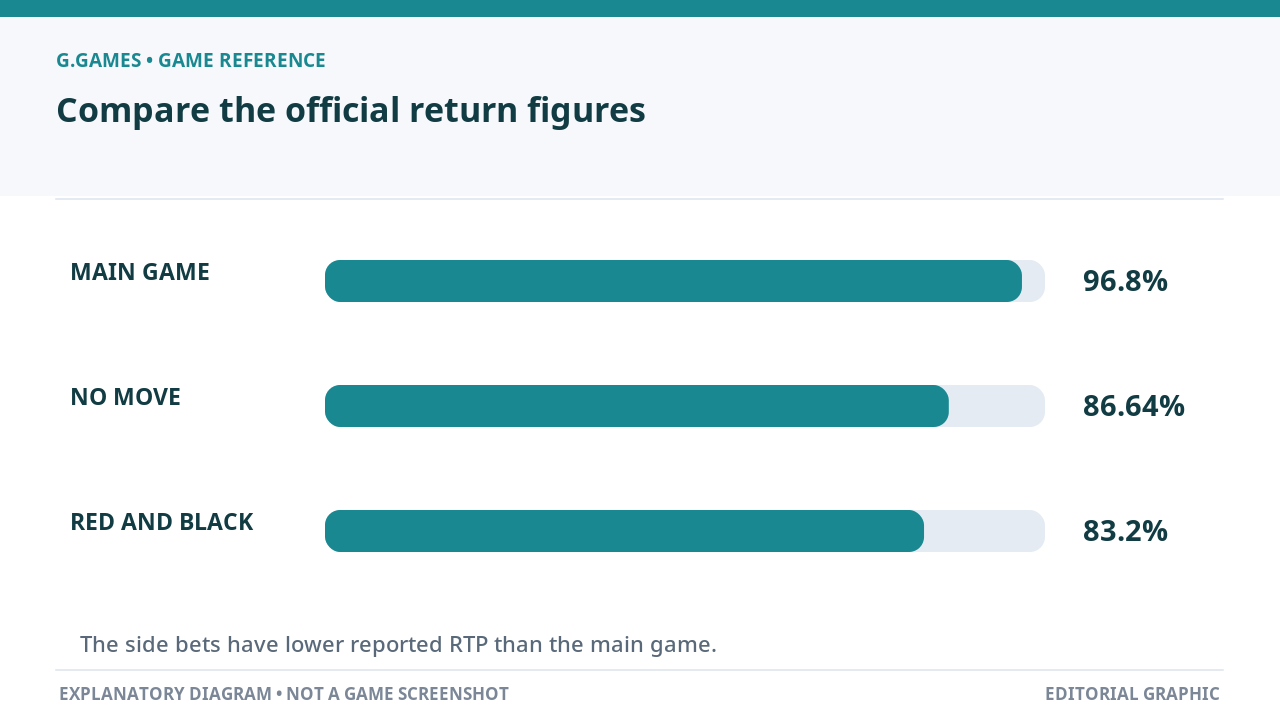
A common error is to describe 96.8% as the return of the whole round when all three wagers are active. It is the published main-game figure. With a side bet added, the amount at risk and the expected return profile change. The two side bets are not reported as 96.8% products.
RTP, skill and randomness
The manufacturer's 96.8% RTP is explicitly based on a player selecting an optimal strategy for each card. In practical terms, the number describes a modeled long-run return across many rounds, not the odds of a profitable single deal and not a minimum result for an individual player. The shuffle is random; players' decisions influence how many cards can be banked.
The same rules describe Auto Play as using the manufacturer's strategy for RTP calculation. That does not make a given deal winnable. Nor does a published RTP mean there is no house advantage: the hypothetical long-run difference between total stakes and total returns remains built into the game, and the side bets have their own reported values.
A reader checking a casino lobby should open the deployed game, verify the help screen and compare the displayed stakes against the official example. Any local version may have different currency increments or jurisdiction-specific restrictions on optional bets.
Example: choosing between two tableau moves
Suppose the face-up top cards include a black Ten and a red Nine, while a black Eight is available elsewhere. Moving the Nine onto the Ten may open space for the Eight, but moving another exposed card to its foundation might uncover hidden information first. Without knowing the concealed cards, this is a decision about options, not a guaranteed profit method.
The manufacturer offers Hint and Auto Play to assist with available moves. The paytable credits cards actually placed on foundations, not the number of good-looking moves or the length of time spent in a hand. If Auto Play finishes with 19 cards on the foundations, the corresponding main prize follows the selected per-card amount, not a separate reward for using Auto Play.
Differences from Retro Solitaire and Vegas Solitaire
| Attribute | Casino Solitaire (G.Games) | Retro Solitaire (G.Games) | Vegas Solitaire (G.Games) |
|---|---|---|---|
| Editorial focus | Confirmed main-game and side-bet paytable | Pixel-art presentation and conflicting RTP sources | Separately released Vegas-themed product |
| Direct manufacturer rules found | Yes | Yes | Not located during this review |
| RTP evidence | Official rules: 96.8% | Official product: 96.9%; rules: 96.8% | Third-party catalogue: 96.8%, not yet confirmed in manufacturer rules |
| Distinct title page | This page | Retro Solitaire | Vegas Solitaire |
The comparison is intentionally narrow. The full mechanics of Retro Solitaire and Vegas Solitaire belong on their own product pages.
Casino Solitaire by G.Games FAQ
Do I have to clear all 52 cards to receive a prize?
No. The main wager pays a stated amount for each card moved to a foundation. A full clear gives the largest possible foundation-card count.
What is the RTP of the G.Games version?
Its official linked rules specify 96.8% for the main game under an optimal strategy assumption. Optional side bets have different listed return values.
Is No Move the same as a no-moves result later in the game?
No. The side bet is determined by the initial deal. Reaching a dead end later in the round does not satisfy the published initial-deal condition.
Can I recycle the stock?
No. The manufacturer says the play deck can be traversed once.
Is this the PureRNG Flipluck game?
No. PureRNG's Casino Solitaire (Flipluck) appears as a distinct catalogue listing and must be checked against its own documentation.
Does Auto Play ensure a win?
No. It attempts to progress according to the program's calculated strategy but may not complete the deck.
Sources and editorial record
- G.Games — Casino Solitaire, product identity, description, date, headline RTP and volatility.
- G.Games / Gamevy — Casino Solitaire rules, version 1.0, main and side-bet tables, move limitations, calculated RTP and Auto Play behavior.
Editorial status: Rules, payout example and the main RTP are supported by a manufacturer-linked document. A current operator help panel is still needed for market-specific stakes and availability. All payouts in this article are gross unless expressly described as results after deducting the example stake.