| Game fact | What the source establishes |
|---|---|
| Title / provider | Retro Solitaire — G.Games |
| Category | Casino card / table game |
| Published release date | 12 November 2020 |
| Cards and layout | 52 cards, seven tableau columns, four foundations |
| Main reward | A stated prize per card moved to a foundation |
| Extra bets | No Move, 15×; Red and Black, 200× |
| Reported RTP | 96.9% on the product page; 96.8% in linked rules |
| Stock | One pass through remaining cards |
Source check: 16 November 2026. Rules are taken from G.Games' linked game-rules document, version 1.0; the product-page RTP is shown separately because it differs.
What makes Retro Solitaire different?
Retro Solitaire does not replace the card game with spinning reels. It keeps the familiar seven-column setup and adds a payment for each card built onto a foundation. The casino element is attached to the player's progress through the deck rather than to a conventional slot payline. G.Games also gives the game an intentionally pixelated presentation, recalling early desktop card games.
Other Klondike variants can use different stakes, controls and returns. This page concerns Retro Solitaire by G.Games alone.
The product listing describes the game as low volatility and lists an advertised top-win figure of “100K.” That label does not identify an ordinary main-bet payout schedule, currency or attainable wager configuration. Check the live game's information panel before treating it as a usable maximum-win amount.
The deal: seven columns, four suit stacks
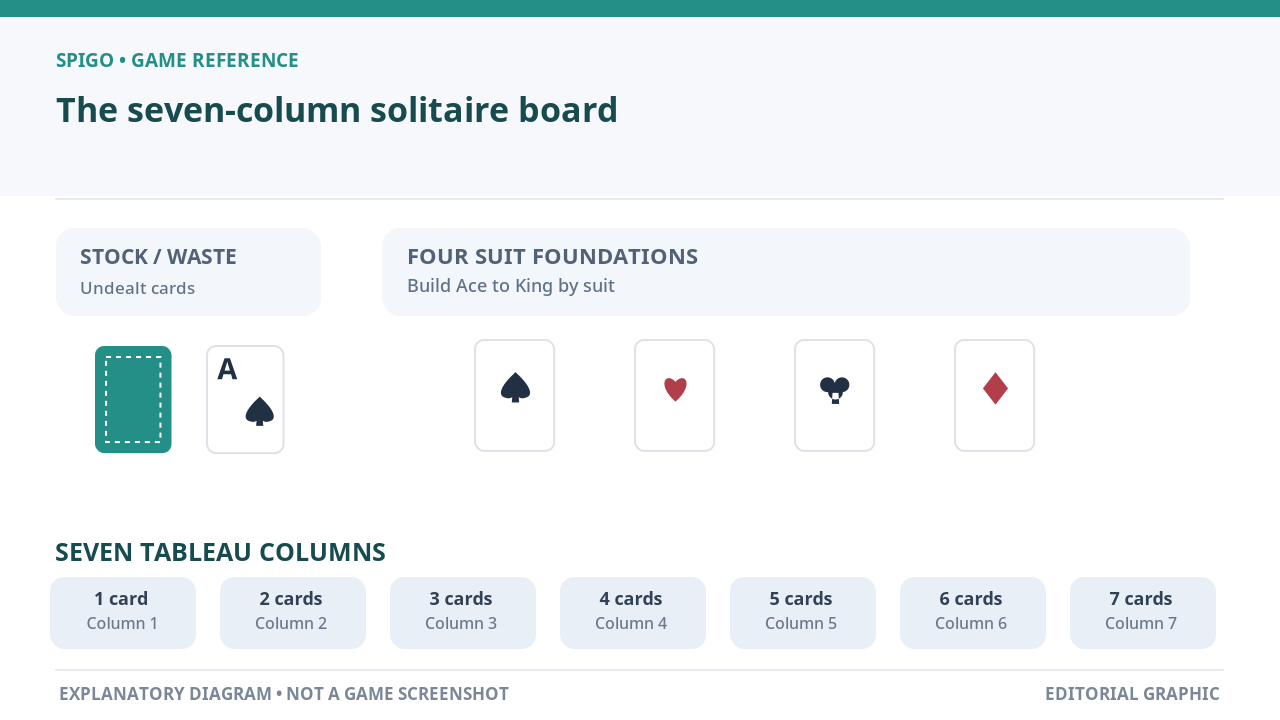
The deck contains 52 shuffled cards. Twenty-eight form the tableau in seven columns holding one, two, three, four, five, six and seven cards. Only the last card in each column begins face up. Four empty foundation spaces appear above the tableau; the undealt cards form the play deck, or stock.
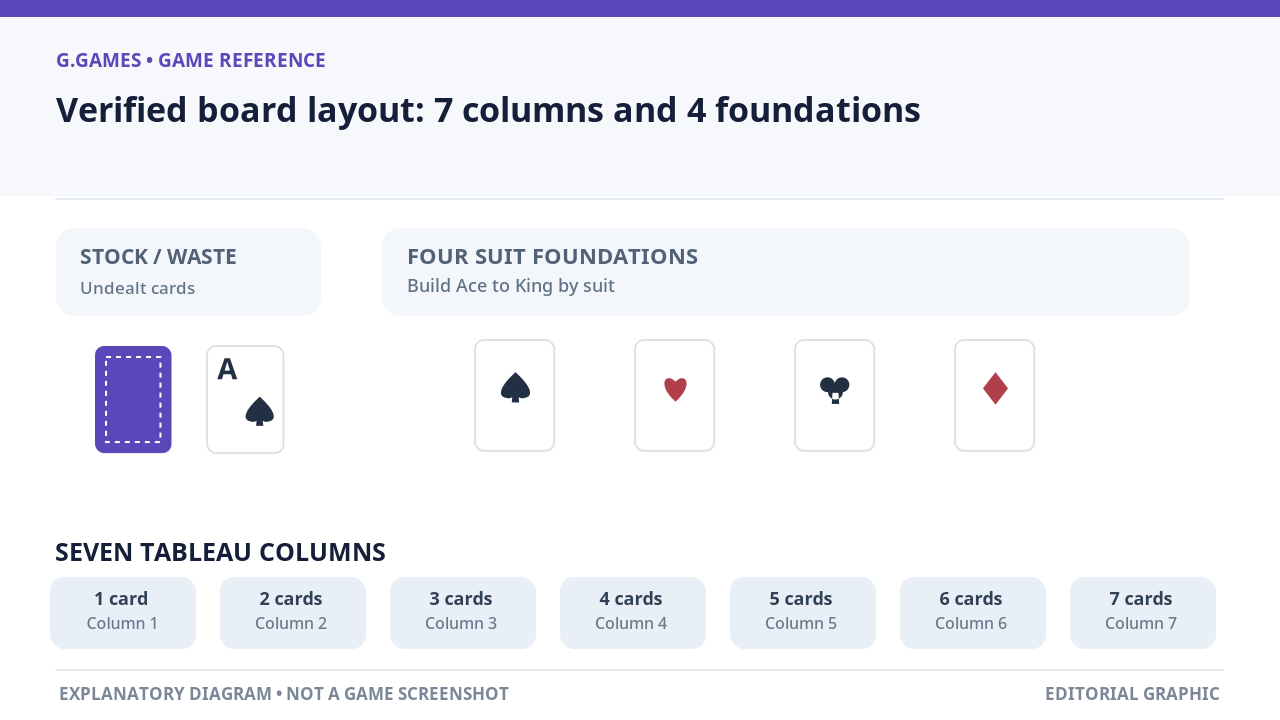
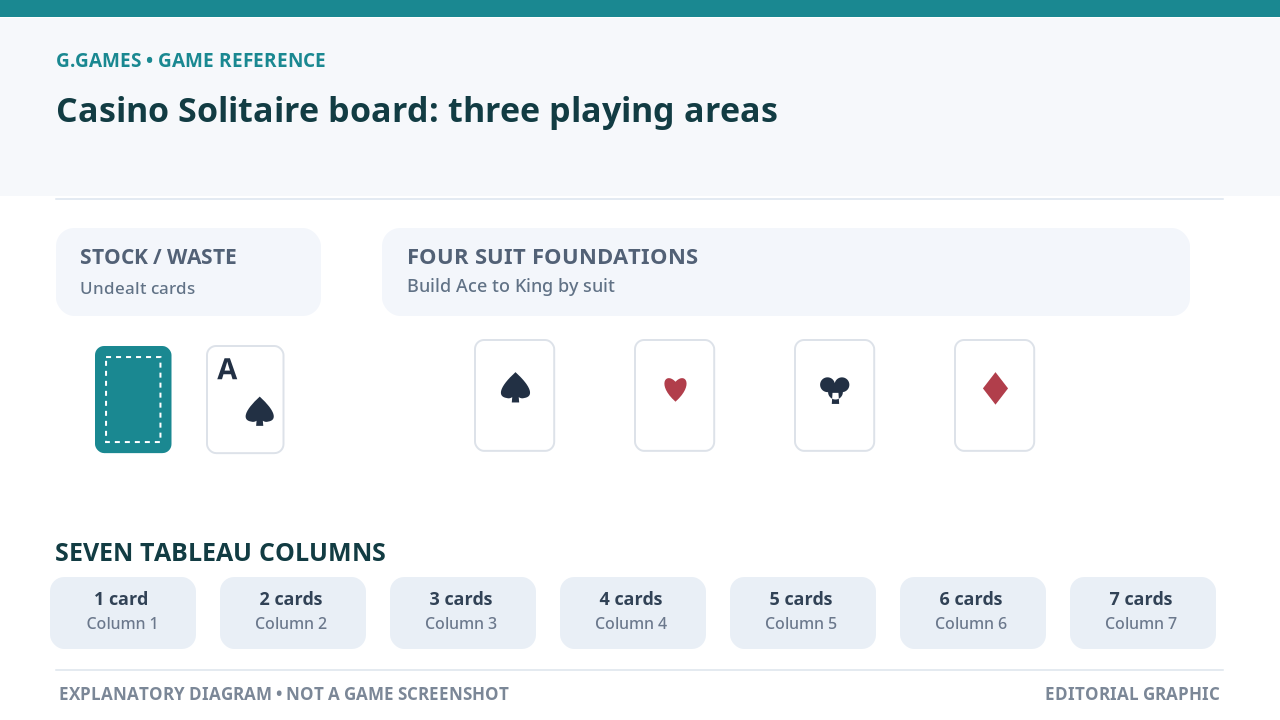
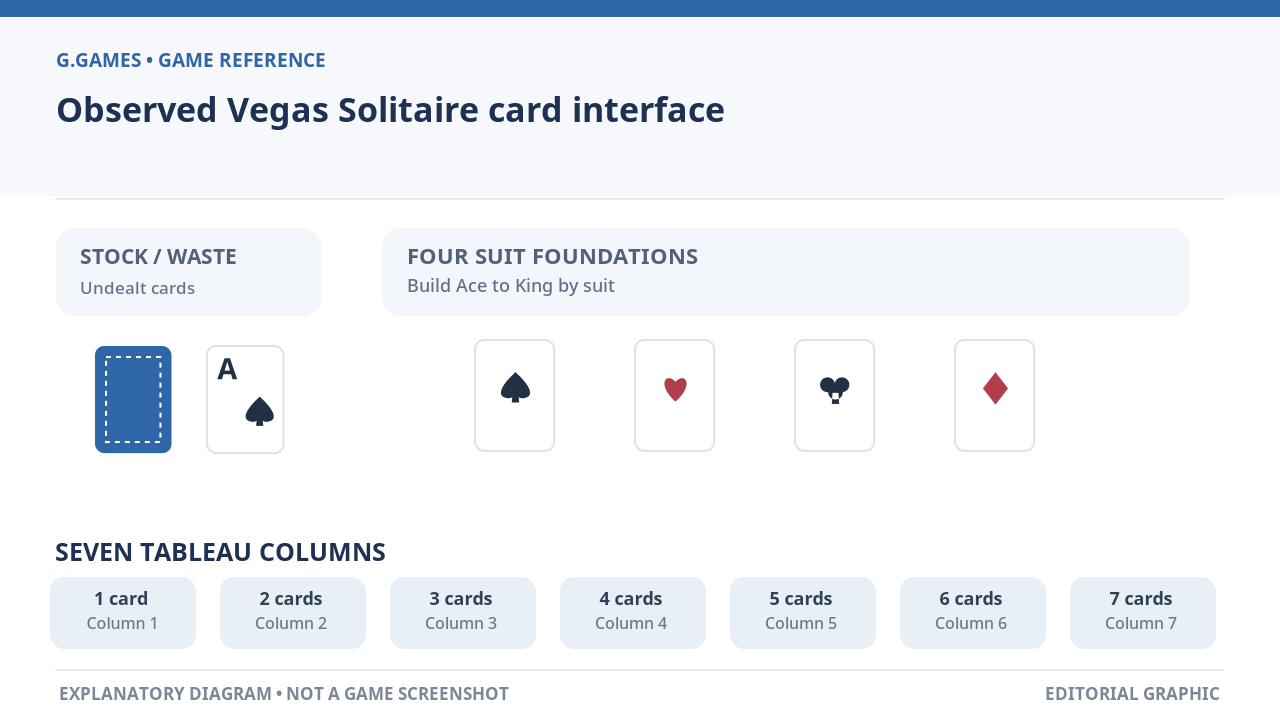
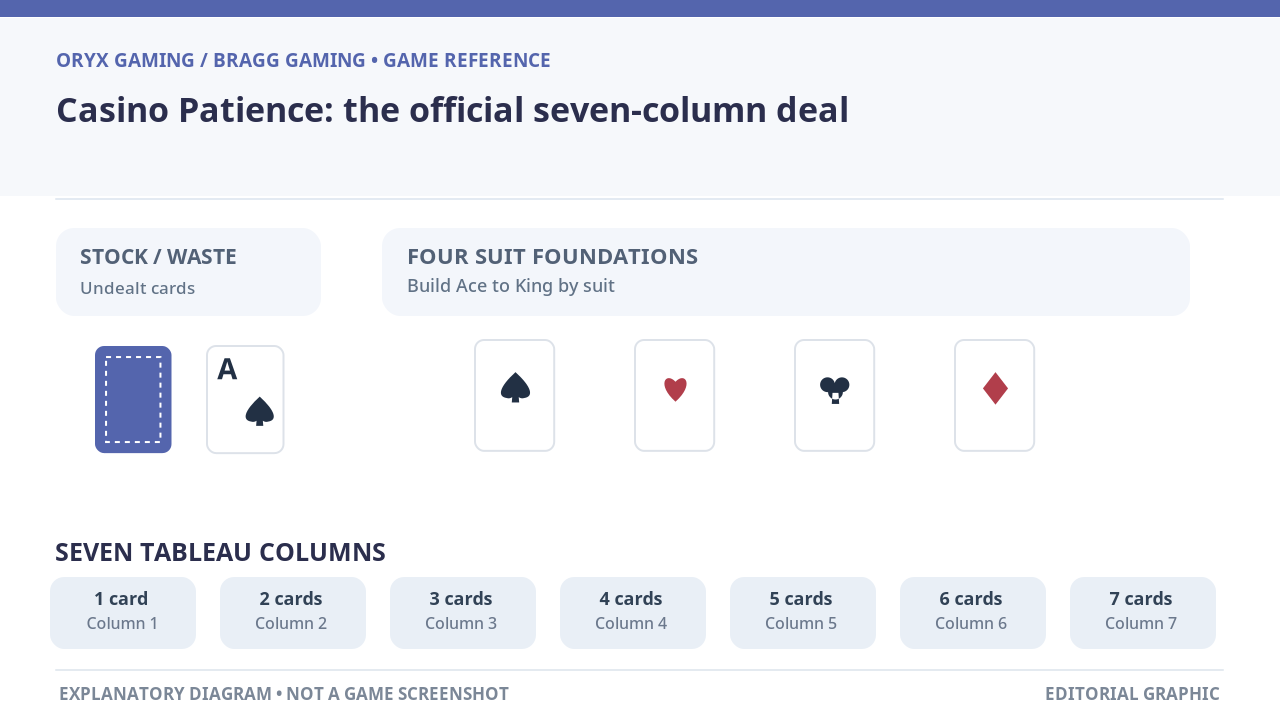
This creates three different areas with different jobs:
- Tableau: columns where exposed cards can be rearranged to uncover hidden cards.
- Foundations: four suit-specific piles built upward from Ace toward King; these drive the main payout.
- Play deck: undealt stock cards, shown one at a time as they are turned over.
The rules state that the play deck may be traversed once. Do not assume unlimited recycling because a free Klondike app permits it. A stock card passed over cannot necessarily be recovered later.
Legal moves in Retro Solitaire
Building the foundations
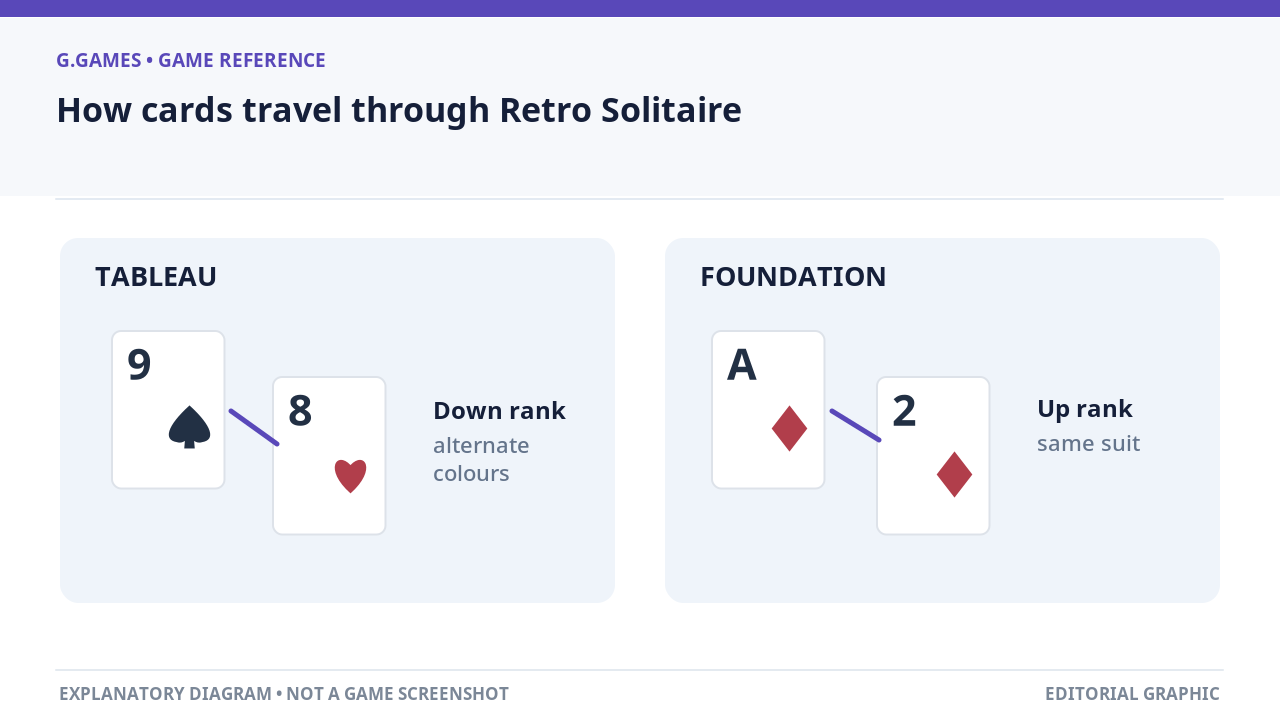
Move an exposed Ace to an empty foundation. Add the Two, Three and subsequent ranks of the same suit in ascending order. A foundation has one suit; placing a card there adds to the count used for the game's main reward. A game completed through all four Kings has transferred all 52 cards.
Moving cards between columns
Tableau runs must descend in rank while alternating red and black. For example, a black Eight can take a red Seven. The player can drag a single eligible card or an exposed descending sequence; clicking the highest card in the group selects the portion to move. When a facedown tableau card is uncovered, it becomes playable.
Double-click can perform an available move; it does not guarantee the best decision for the whole round. Consider hidden cards before sending cards to a foundation.
Stock, Hint, Undo and Auto Play
The on-screen stock counter indicates the number of cards left in the play deck. Hint identifies an available move. The linked rules describe a single Undo for turning a play-deck card or moving a card from a tableau column to a foundation, but not for exposing one of the facedown tableau cards. Auto Play finishes a solvable game where the function can complete it. End Game forfeits the ongoing round and returns to stake selection.
Those Undo restrictions have consequences. It is safer to inspect a possible tableau sequence before exposing its next hidden card, because the exposure itself cannot be taken back under the documented rule. Hint and Auto Play should not be mistaken for a cash-out guarantee.
How the main bet pays
Before dealing, the bet screen states the amount paid per foundation card. The primary award is cumulative: each successfully placed card contributes a stated amount; collecting all 52 cards reaches the full-card result shown by that particular stake option.
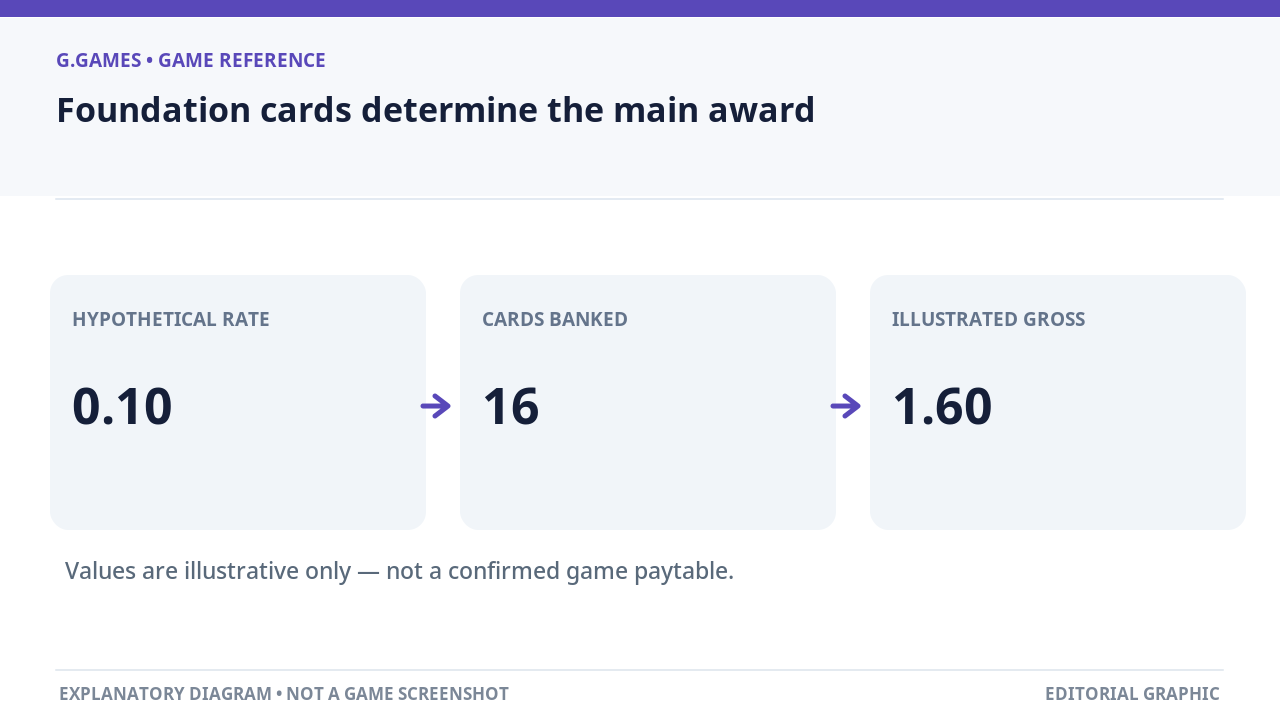
A simple calculation shows the model without claiming an unverified Retro Solitaire paytable. Suppose, hypothetically, the game screen offers a £0.10 award per card. If you place 16 cards on foundations, the total illustrated main-game award is 16 × £0.10 = £1.60. If you place all 52, the illustrated amount becomes £5.20. These numbers describe arithmetic only; they are not confirmed Retro Solitaire bet options.
| Foundation cards moved | Illustrative prize at £0.10/card |
|---|---|
| 0 | £0.00 |
| 8 | £0.80 |
| 16 | £1.60 |
| 32 | £3.20 |
| 52 | £5.20 |
This table lists gross awards, not player profit. To calculate net result, subtract the actual main stake and any optional side-bet stakes from the combined prize. The real game screen's per-card value always takes precedence over the sample.
Optional side bets: two separate conditions
The rules name two extra bets resolved by the starting deal. They are not bonuses earned through ordinary progression to the foundations.
| Side bet | Published winning condition | Published prize |
|---|---|---|
| No Move | No initial move is possible from the deal | 15× the side-bet stake |
| Red and Black | Starting hand consists entirely of red cards or entirely of black cards, including the card on the stock pile | 200× the side-bet stake |
For Red and Black, the stock-pile card is expressly included. Looking only at the exposed tableau cards would miss part of the stated condition. For No Move, the rules use the phrase “no initial move possible”; follow the game's adjudication rather than applying a home-game interpretation of movable stock cards.
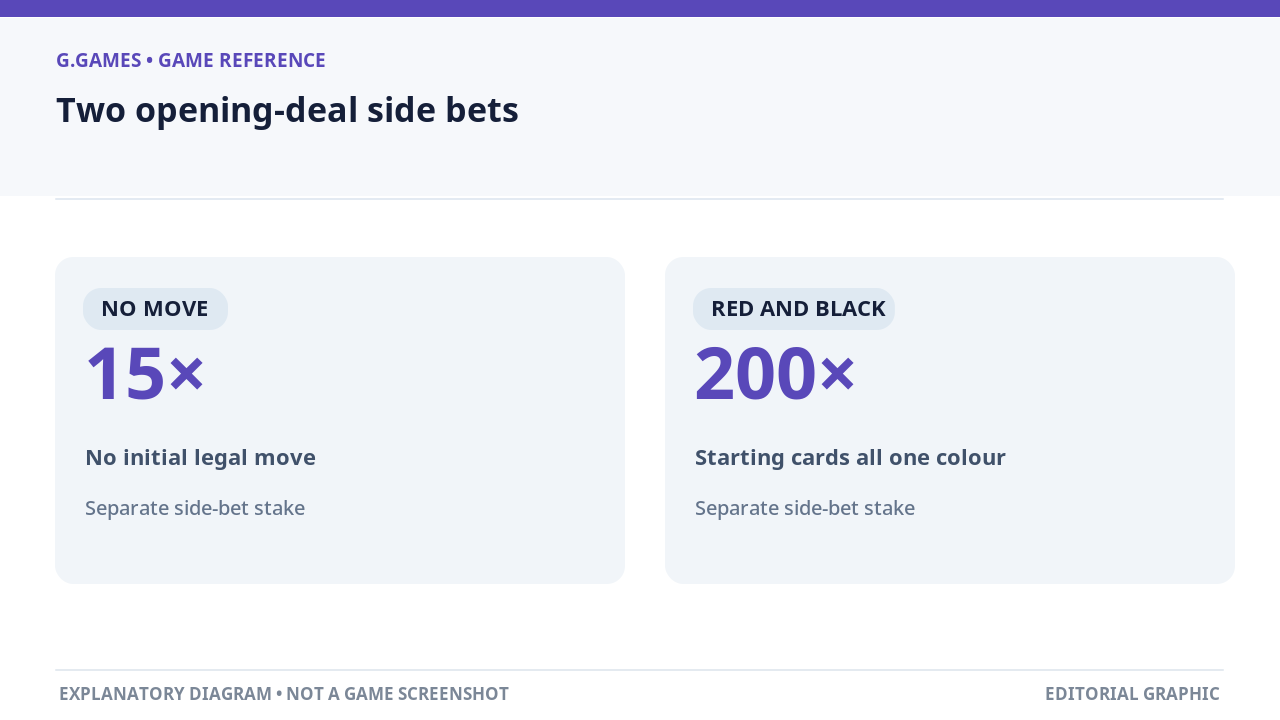
The published factors are prizes against their respective side-bet stakes, not multipliers on the main game's 52-card award. Extra bets increase the amount exposed on a round. No evidence in the linked rules shows that either option improves the main game's stated return.
Retro Solitaire RTP: why two official numbers appear
The G.Games product page reports 96.9% RTP. The linked Retro Solitaire rules, version 1.0, state 96.8% and specify an assumption that the player chooses an optimal strategy for each card. Both are supplier-controlled materials. They currently disagree by 0.1 percentage point.
| Source | RTP shown | Interpretation |
|---|---|---|
| G.Games product listing | 96.9% | Product-level headline figure |
| Game-rules document, version 1.0 | 96.8% | Long-run estimate assuming optimal decisions |
The discrepancy might reflect different builds, a later update or an error in one publication. None of those explanations is confirmed here. The relevant operator's in-game rules and certified paytable should settle the figure for a specific game build.
Return to player is a long-run statistical measure, not the amount returned on one hand. Card order is random and decisions affect progress. A single failed deal, a successful full clear and a sequence of small card awards cannot validate or disprove the stated percentage.
A realistic decision sequence
Imagine a starting tableau exposing a black Nine above a red Eight in another column, while a red Ace is ready for a foundation. The Ace can be moved immediately. The red Eight could also move onto the black Nine, potentially uncovering a facedown card. A player must evaluate which order preserves options under the one-pass stock rule.
This is an illustrative position, not a recreation of a recorded deal. It shows why the game's skill component is relevant: the same shuffled deck can lead to different foundation totals depending on which available moves the player takes and in what order.
Retro Solitaire versus G.Games' other card titles
| Question | Retro Solitaire | Casino Solitaire by G.Games | Vegas Solitaire by G.Games |
|---|---|---|---|
| Main identity | Pixel-art nostalgia | Casino-branded Klondike | Vegas-themed variant |
| Foundation-card payouts | Published in official rules | Published in official rules | Reported by independent game guides; verify against live help |
| Two extra bets | Confirmed in official rules | Confirmed in official rules | Shown in third-party interface coverage |
| Game-specific source strength | Product page and official rules | Product page and detailed official rules | Mainly third-party coverage reviewed here |
For the exact mechanics of the other versions, see Casino Solitaire by G.Games and Vegas Solitaire by G.Games. Names, stakes and results should not be transferred between products without checking their own rules.
Retro Solitaire FAQ
How many cards are in Retro Solitaire?
There are 52 cards. Twenty-eight begin in seven tableau columns and the rest form the play deck.
Can I go through the stock more than once?
No. The G.Games rules specify one pass through the play deck.
Does Retro Solitaire pay for each foundation card?
Yes. The main bet states a prize per card placed onto the suit stacks. Actual stake options and per-card values are displayed before the deal.
Is the RTP 96.9% or 96.8%?
The product page says 96.9%; its linked rules say 96.8% based on optimal play. Check the deployed game's own rules for the applicable figure.
Can I undo every mistake?
No. The rules allow one Undo for specified move types and exclude turning over a facedown tableau card.
Are the side bets required?
They are described as optional. Their availability can depend on the operator and local rules.
Sources and editorial record
- G.Games — Retro Solitaire product listing, including release date, styling, headline RTP and side-bet overview.
- G.Games / Gamevy — Retro Solitaire game rules, version 1.0, for deal, controls, prizes and the different RTP figure.
Editorial status: Core mechanics confirmed from official materials; RTP discrepancy unresolved. Check the operator's current in-game rules before publication of a single numerical RTP claim. This article describes the game and does not recommend gambling or promise a return.